Behavioural Tradition

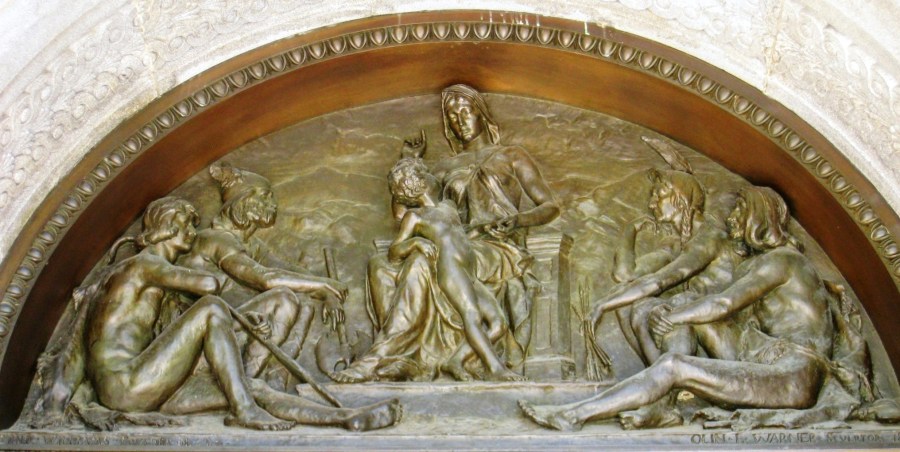
Looking at the Bible through this lense shows that the Bible is a historical documentation of the human behavioral tradition, from the demands of adaptation to nature, in the form of heuristics.

The (explicit) moral code is validated by reference to the (religious, mythic) narrative, the narrative; is primarily episodic representation of behavioral tradition; the tradition emerges as a consequence of individual adaptation to the demands of natural conditions, manifest (universally) in emotion, generated in a social context. The episodic representation – which is representation of the outcome of a procedure and the procedure itself – is predicated upon belief in the sufficiency and validity of that procedure; more subtly, it has the same structure – at least insofar as it is an accurate representation of behavior – and therefore contains the (implicit) hierarchical structure of historically determined procedural knowledge in more explicit form. Over lengthy historical periods, therefore, the “image” ever more accurately encapsulates the behavior, and stories find their compelling essential form.

Jordan Peterson

Understanding Morality

It is still the case, however, that description of the domain of morality tend to exceed the capability of declarative thought, and that the nature of much of what we think of as moral behavior is still, therefore, embedded in unconscious procedure. As a consequence, it is easy for us to become confused about the nature of morality, and to draw inappropriate, untimely and dangerous “fixed” conclusions.

Moral behaviors and schemas of valuation arise as a consequence of behavioral interaction undertaken in the social world: every individual, motivated to regulate his emotions through action, modifies the behavior of others, operating in the same environment. The consequence of this mutual modification, operating over time, is the emergence of a stable pattern of behavior, “designed” to match individual and social needs, simultaneously. Eventually, this behavioral pattern comes to be coded in image, heralded and narrative, and explicitly represented in words.

Myths of the “knowledge of good and evil” and the “fall from paradise” represent emergence of this representational capacity, in the guise of a historical event. The consequence of this “event” – that is, the development of “self-consciousness” – is capacity to represent death and understand that the possibility of death is part of the unknown.

These complex systems of action and belief are religious. They are the traditional means of dealing with the shadow cast on life by the knowledge of mortality. Our inability to understand the religious traditions and our consequent conscious denigration of their perspectives dramatically decrease the utility of what they have to offer.

We are conscious enough to destabilize our beliefs and our traditional patterns of action, but not conscious enough to understand them. If the reasons for the existence of our traditions were rendered more explicit, however, perhaps we could develop greater intrapsychic and social integrity. The capacity to develop such understanding might help us use our capacity for reason to support, rather than destroy, the moral systems that discipline and protect us.

Jordan Peterson

Primordial Chaos

The totality of the world, which includes the significance of experienced things, as well as the things themselves, is composed of what has been explored and rendered familiar; what has yet to be encountered, and is therefore unpredictable; and the process that mediates between the two.

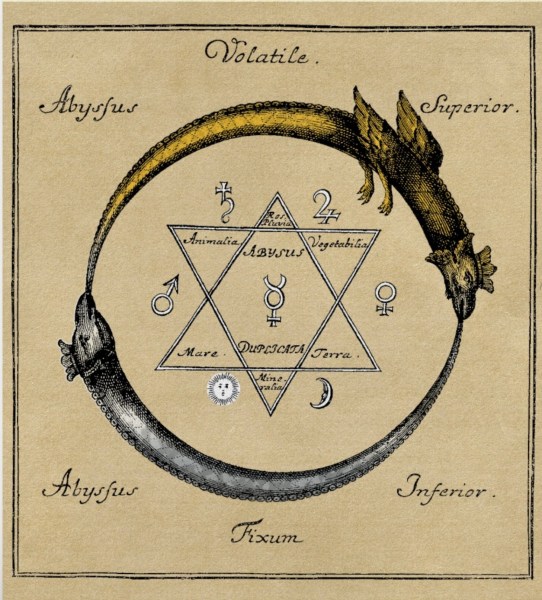
The primordial theriomorphic serpent god is endless potential; is whatever being is prior to the emergence of the capacity for experience. This potential has been represented as the self devouring dragon (most commonly) because this image aptly symbolizes the union of incommensurate opposites. Th ouroboros is simultaneously representative of two antithetical primordial elements. As a snake, the ouroboros is a creature of the ground, of matter; as a bird (a winged animal), it is a creature of the air, the sky, spirit. The ouroborus symbolizes the union of the known (associated with spirit) and unknown (associated with matter), explored and unexplored; symbolizes the juxtaposition of the “masculine” principles of security, tyranny and order with the “feminine” principles of darkness, dissolution, creativity and chaos.

Furthermore, as a snake, the ouroboros has the capacity to shed its skin – to be “reborn.” Thus, it also represents the possibility of transformation, and stands for the knower, who can transform chaos into order, and order into chaos. The Ouroboros stands for, or comprises, everything that is as of yet unencountered, prior to its differentiation as a consequence of active exploration and classification. It is a source of all information that makes up the determinant world of experience and is, simultaneously, the birthplace of the experiencing subject.

The ouroboros is one thing, as everything that has not yet been explored is one thing; it exists everywhere, and at all times. It is completely self-contained, completely self-referential: it feeds, fertilizes and engulfs itself. It unites the beginning and the end, being and becoming, in the endless circle of its existence. It serves as a symbol for the ground of reality itself. It is the “set of all things that not yet things,” the primal origin and ultimate point of return for every discriminable object and every independent subject. It serves as progenitor of all we know, all that we don’t know, and of the spirit that constitutes our capacity to know and not know. It is the mystery that constantly emerges when solutions to old problems cause new problems; is the sea of chaos surrounding man’s island of knowledge – and the source of that knowledge, as well. It is all new experience generated by time, which incessantly works to transform the temporarily predictable once again into the unknown. It has served mankind as the most ubiquitous and potent primordial gods.

Jordan Peterson

Temple Initiation

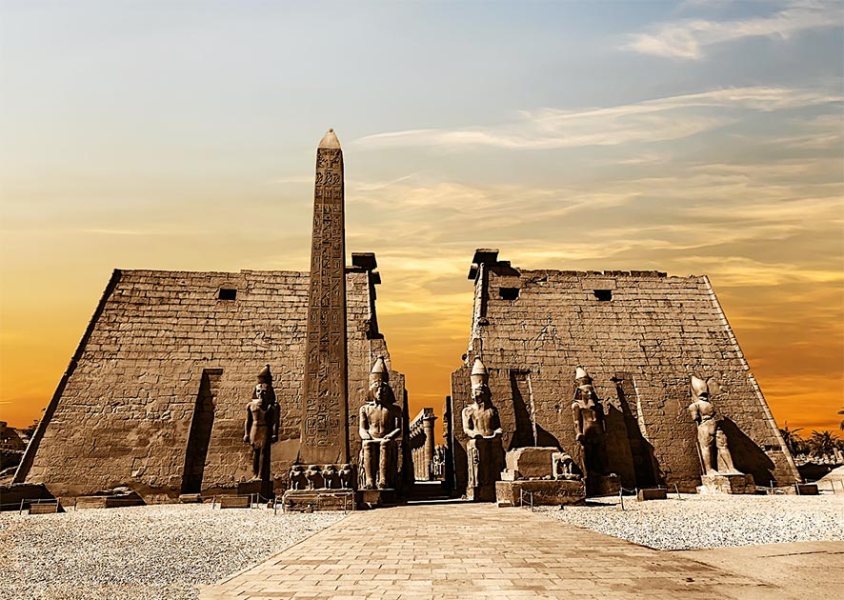
To truly enter the Temple a change in mind set must occur, this is sometimes referred to as “the process of initiation into the Mysteries” – the development of the intelligence of the heart – the Initiate must learn to focus on the inside rather than the outside and look beyond the visible to the invisible, to what lies beneath and the world within.


Its precisely the things we don’t see – we can’t see – that were the secrets of the Mystery schools. A sometimes difficult concept to grasp, it can require an adjustment in thinking and perception, as it focuses not on the physical, material world, but on its underlying causes. The great Mysteries concerned the invisible laws, forces, archetypes, and secret connections that are the building blocks – the invisible templates of our reality – and perhaps the roadmap to operating in higher realms as well.

Magical Egypt Episode 1

Thought

Thinking is indispensable to us. It is essential for belief formation, planning, explicit learning, moral reasoning, and many other capacities that make us human. Thinking is the basis of every social relationship and cultural institution we have. It is also the foundation of science. But our habitual identification with thought – that is, our failure to recognize thoughts as thoughts, as appearances in consciousness – is a primary source of human suffering. It also gives rise to the illusion that a separate self is living inside one’s head.

We spend our lives lost in thought. The question is, what should we make of this fact? In the West, the the answer has been “Not much.” In the East, especially in contemplative traditions like those of Buddhism, being distracted by thought is understood to be the very wellspring of human suffering.

From the contemplative point of view, being lost in thoughts of any kind, pleasant or unpleasant, is analogous to being asleep and dreaming. It’s a mode of not knowing what is actually happening in the present moment. It is essentially a form of psychosis. Thought itself is not a problem, but being identified with thought is. Taking oneself to be the thinker of one’s thoughts – that is, not recognizing the present thought to be a transitory appearance of consciousness – is a delusion that produces nearly every species of human conflict and unhappiness. It doesn’t matter if your mind is wandering over current problems in set theory or cancer research; if you are thinking without knowing you are thinking, you are confused about who and what you are.

Sam Harris