Meaning of Myth

The myths of a culture are its central stories. These stories provide a dramatic record of the historically predicated transformation of human intent, and appear to exist as the episodic/semantic embodiment of history’s cumulative effect on action.

The mythical narratives that accompany retention of historically determined behavior constitute non-empirical episodic representation of that behavior and its method of establishment. Myth is purpose, coded in episodic memory. Mythic truth is information, derived from past experience – derived from past observation of behavior – relevant from the perspective of fundamental motivation and effect.

Myth simultaneously provides a record of historical essential, in terms of behavior, and programs those historical essentials. Narrative provides semantic description of action in image, back translatable into imaginary episodic events, capable of eliciting imitative behavior.

Mythic narrative offers dramatic presentation of morality, which is the study of what should be. Such narrative concerns itself with the meaning of the past, with the implications of past existence for current and future activity. This meeting constitutes the ground for the organization of behavior.

Myth has come to encapsulate and express the essential nature of the exploratory, creative, communicative psyche, as manifested in behavior, as a consequence of observation and representation of that behavior, in the temporally summed, historically determined manner beginning with imitation and ending with verbal abstraction.

Jordan Peterson

Behavioural Tradition

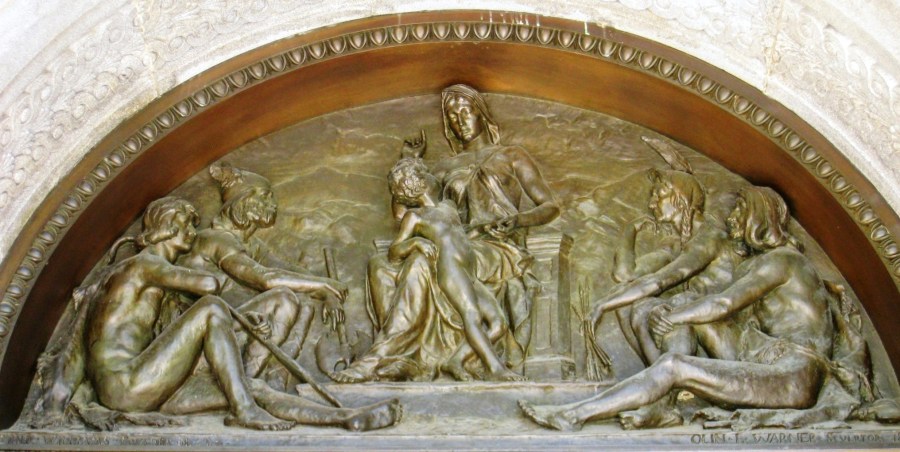
Looking at the Bible through this lense shows that the Bible is a historical documentation of the human behavioral tradition, from the demands of adaptation to nature, in the form of heuristics.

The (explicit) moral code is validated by reference to the (religious, mythic) narrative, the narrative; is primarily episodic representation of behavioral tradition; the tradition emerges as a consequence of individual adaptation to the demands of natural conditions, manifest (universally) in emotion, generated in a social context. The episodic representation – which is representation of the outcome of a procedure and the procedure itself – is predicated upon belief in the sufficiency and validity of that procedure; more subtly, it has the same structure – at least insofar as it is an accurate representation of behavior – and therefore contains the (implicit) hierarchical structure of historically determined procedural knowledge in more explicit form. Over lengthy historical periods, therefore, the “image” ever more accurately encapsulates the behavior, and stories find their compelling essential form.

Jordan Peterson

Primordial Chaos

The totality of the world, which includes the significance of experienced things, as well as the things themselves, is composed of what has been explored and rendered familiar; what has yet to be encountered, and is therefore unpredictable; and the process that mediates between the two.

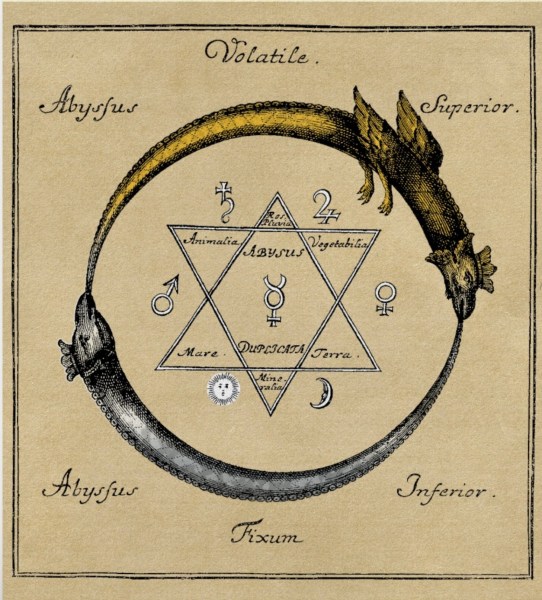
The primordial theriomorphic serpent god is endless potential; is whatever being is prior to the emergence of the capacity for experience. This potential has been represented as the self devouring dragon (most commonly) because this image aptly symbolizes the union of incommensurate opposites. Th ouroboros is simultaneously representative of two antithetical primordial elements. As a snake, the ouroboros is a creature of the ground, of matter; as a bird (a winged animal), it is a creature of the air, the sky, spirit. The ouroborus symbolizes the union of the known (associated with spirit) and unknown (associated with matter), explored and unexplored; symbolizes the juxtaposition of the “masculine” principles of security, tyranny and order with the “feminine” principles of darkness, dissolution, creativity and chaos.

Furthermore, as a snake, the ouroboros has the capacity to shed its skin – to be “reborn.” Thus, it also represents the possibility of transformation, and stands for the knower, who can transform chaos into order, and order into chaos. The Ouroboros stands for, or comprises, everything that is as of yet unencountered, prior to its differentiation as a consequence of active exploration and classification. It is a source of all information that makes up the determinant world of experience and is, simultaneously, the birthplace of the experiencing subject.

The ouroboros is one thing, as everything that has not yet been explored is one thing; it exists everywhere, and at all times. It is completely self-contained, completely self-referential: it feeds, fertilizes and engulfs itself. It unites the beginning and the end, being and becoming, in the endless circle of its existence. It serves as a symbol for the ground of reality itself. It is the “set of all things that not yet things,” the primal origin and ultimate point of return for every discriminable object and every independent subject. It serves as progenitor of all we know, all that we don’t know, and of the spirit that constitutes our capacity to know and not know. It is the mystery that constantly emerges when solutions to old problems cause new problems; is the sea of chaos surrounding man’s island of knowledge – and the source of that knowledge, as well. It is all new experience generated by time, which incessantly works to transform the temporarily predictable once again into the unknown. It has served mankind as the most ubiquitous and potent primordial gods.

Jordan Peterson

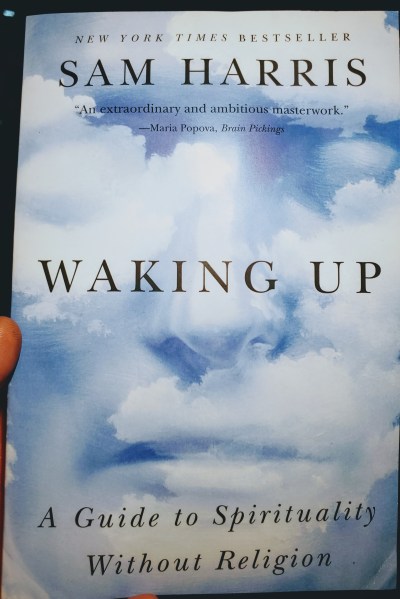
Waking Up (A Guide to Spirituality Without Religion)

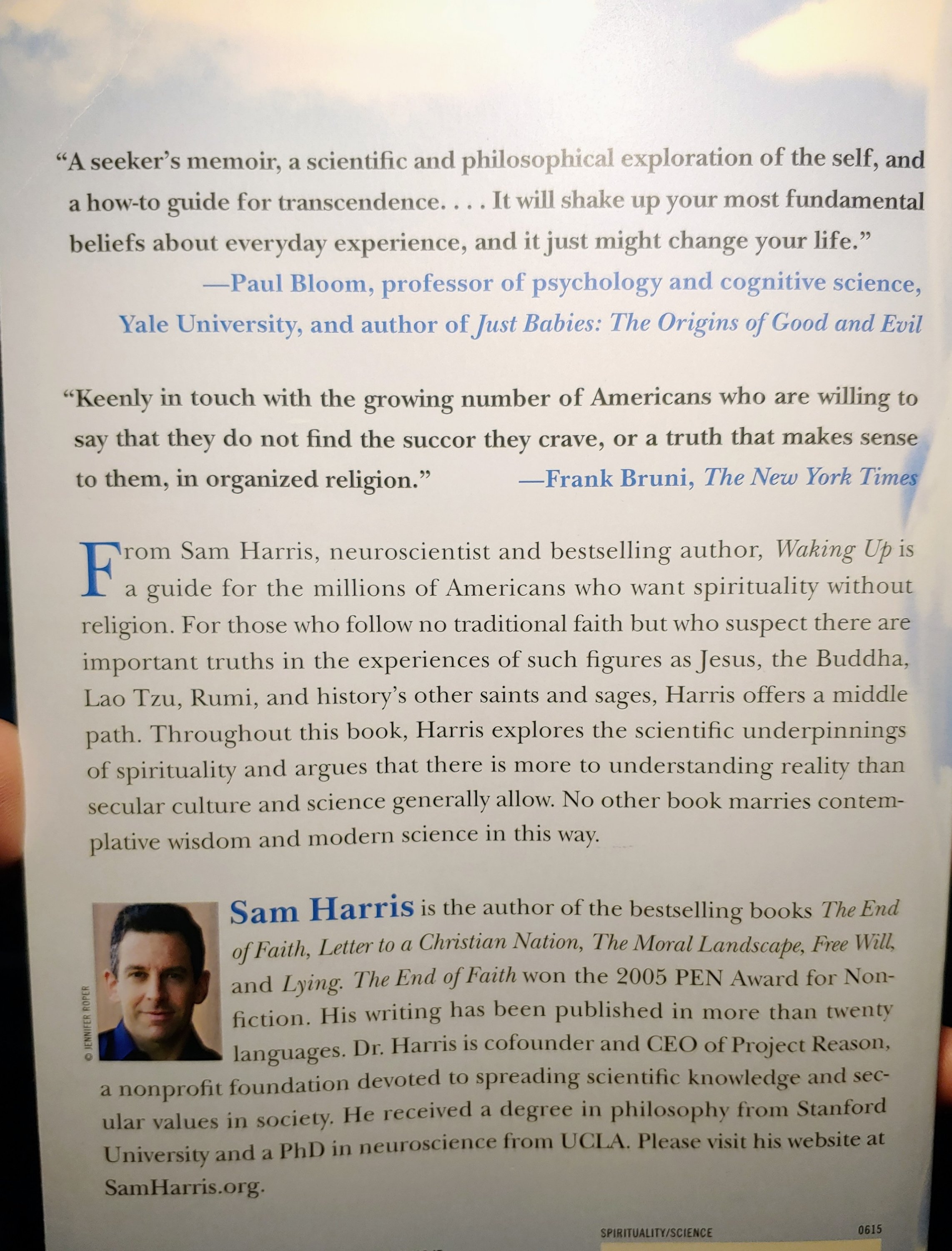
In this book Sam goes into deatil on how one can have spirituality without religion. Understanding this fact, I feel, is crucial for the advancement of human kind. It’s absolutely imperative for the expansion of conciousness to seperate spirituality from religion. Most often people use religion to put a personal spiritual experience into context, though, most don’t know that religion and it’s dogmatism isn’t necessary for one to put it into context, and in certain cases is more harmful to the individual to do so. Fertile ground for a spirtual consciousness does not lie in restrictive dogmatic superstitions.

20% of Americans describe themselves as “spiritual but not religious.” Although the claim seems to annoy believers and atheists equally, separating spirituality from religion is a perfectly reasonable thing to do. It is to assert two important truths simultaneously: Our world is dangerously riven by religious doctrines that all educated people should condemn, and yet there is more to understanding the human condition than science and secular cultural generally admit. One purpose of this book is to give both these convictions intellectual and empirical support

Sam Harris