Behavioural Tradition

Looking at the Bible through this lense shows that the Bible is a historical documentation of the human behavioral tradition, from the demands of adaptation to nature, in the form of heuristics.

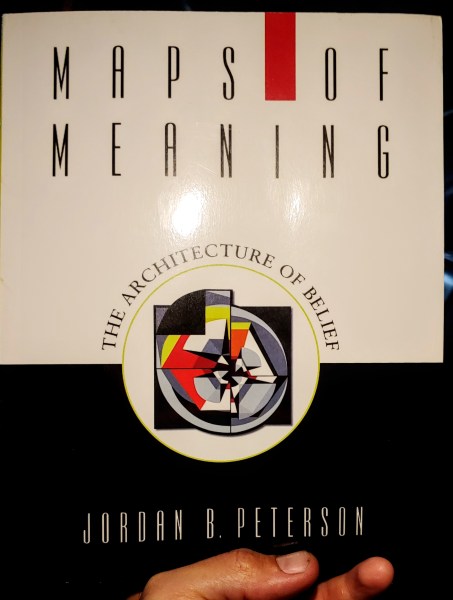
The (explicit) moral code is validated by reference to the (religious, mythic) narrative, the narrative; is primarily episodic representation of behavioral tradition; the tradition emerges as a consequence of individual adaptation to the demands of natural conditions, manifest (universally) in emotion, generated in a social context. The episodic representation – which is representation of the outcome of a procedure and the procedure itself – is predicated upon belief in the sufficiency and validity of that procedure; more subtly, it has the same structure – at least insofar as it is an accurate representation of behavior – and therefore contains the (implicit) hierarchical structure of historically determined procedural knowledge in more explicit form. Over lengthy historical periods, therefore, the “image” ever more accurately encapsulates the behavior, and stories find their compelling essential form.

Jordan Peterson

Understanding Morality

It is still the case, however, that description of the domain of morality tend to exceed the capability of declarative thought, and that the nature of much of what we think of as moral behavior is still, therefore, embedded in unconscious procedure. As a consequence, it is easy for us to become confused about the nature of morality, and to draw inappropriate, untimely and dangerous “fixed” conclusions.

Moral behaviors and schemas of valuation arise as a consequence of behavioral interaction undertaken in the social world: every individual, motivated to regulate his emotions through action, modifies the behavior of others, operating in the same environment. The consequence of this mutual modification, operating over time, is the emergence of a stable pattern of behavior, “designed” to match individual and social needs, simultaneously. Eventually, this behavioral pattern comes to be coded in image, heralded and narrative, and explicitly represented in words.

Myths of the “knowledge of good and evil” and the “fall from paradise” represent emergence of this representational capacity, in the guise of a historical event. The consequence of this “event” – that is, the development of “self-consciousness” – is capacity to represent death and understand that the possibility of death is part of the unknown.

These complex systems of action and belief are religious. They are the traditional means of dealing with the shadow cast on life by the knowledge of mortality. Our inability to understand the religious traditions and our consequent conscious denigration of their perspectives dramatically decrease the utility of what they have to offer.

We are conscious enough to destabilize our beliefs and our traditional patterns of action, but not conscious enough to understand them. If the reasons for the existence of our traditions were rendered more explicit, however, perhaps we could develop greater intrapsychic and social integrity. The capacity to develop such understanding might help us use our capacity for reason to support, rather than destroy, the moral systems that discipline and protect us.

Jordan Peterson

Primordial Chaos

The totality of the world, which includes the significance of experienced things, as well as the things themselves, is composed of what has been explored and rendered familiar; what has yet to be encountered, and is therefore unpredictable; and the process that mediates between the two.

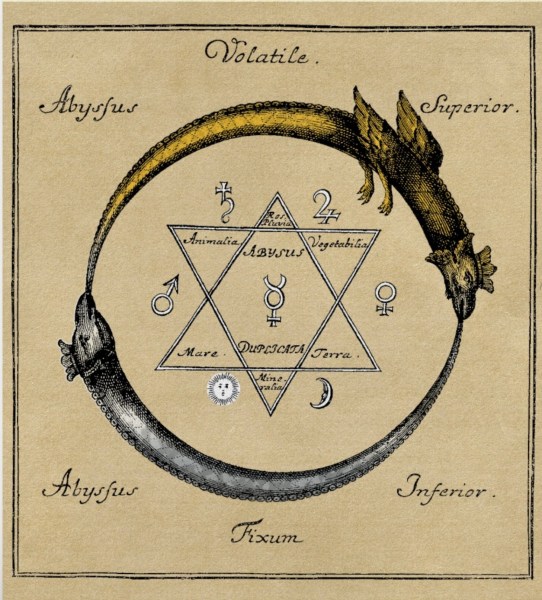
The primordial theriomorphic serpent god is endless potential; is whatever being is prior to the emergence of the capacity for experience. This potential has been represented as the self devouring dragon (most commonly) because this image aptly symbolizes the union of incommensurate opposites. Th ouroboros is simultaneously representative of two antithetical primordial elements. As a snake, the ouroboros is a creature of the ground, of matter; as a bird (a winged animal), it is a creature of the air, the sky, spirit. The ouroborus symbolizes the union of the known (associated with spirit) and unknown (associated with matter), explored and unexplored; symbolizes the juxtaposition of the “masculine” principles of security, tyranny and order with the “feminine” principles of darkness, dissolution, creativity and chaos.

Furthermore, as a snake, the ouroboros has the capacity to shed its skin – to be “reborn.” Thus, it also represents the possibility of transformation, and stands for the knower, who can transform chaos into order, and order into chaos. The Ouroboros stands for, or comprises, everything that is as of yet unencountered, prior to its differentiation as a consequence of active exploration and classification. It is a source of all information that makes up the determinant world of experience and is, simultaneously, the birthplace of the experiencing subject.

The ouroboros is one thing, as everything that has not yet been explored is one thing; it exists everywhere, and at all times. It is completely self-contained, completely self-referential: it feeds, fertilizes and engulfs itself. It unites the beginning and the end, being and becoming, in the endless circle of its existence. It serves as a symbol for the ground of reality itself. It is the “set of all things that not yet things,” the primal origin and ultimate point of return for every discriminable object and every independent subject. It serves as progenitor of all we know, all that we don’t know, and of the spirit that constitutes our capacity to know and not know. It is the mystery that constantly emerges when solutions to old problems cause new problems; is the sea of chaos surrounding man’s island of knowledge – and the source of that knowledge, as well. It is all new experience generated by time, which incessantly works to transform the temporarily predictable once again into the unknown. It has served mankind as the most ubiquitous and potent primordial gods.

Jordan Peterson

Temple Initiation

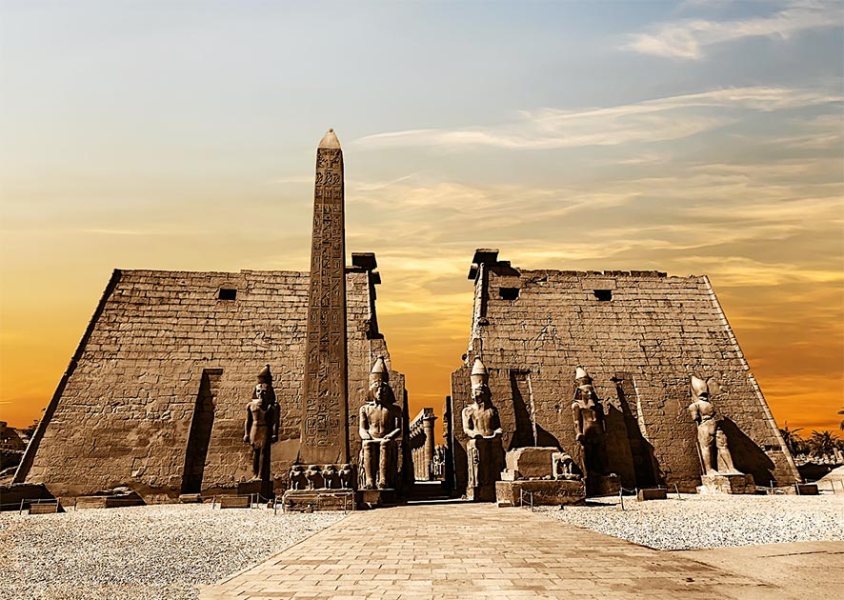
To truly enter the Temple a change in mind set must occur, this is sometimes referred to as “the process of initiation into the Mysteries” – the development of the intelligence of the heart – the Initiate must learn to focus on the inside rather than the outside and look beyond the visible to the invisible, to what lies beneath and the world within.


Its precisely the things we don’t see – we can’t see – that were the secrets of the Mystery schools. A sometimes difficult concept to grasp, it can require an adjustment in thinking and perception, as it focuses not on the physical, material world, but on its underlying causes. The great Mysteries concerned the invisible laws, forces, archetypes, and secret connections that are the building blocks – the invisible templates of our reality – and perhaps the roadmap to operating in higher realms as well.

Magical Egypt Episode 1

Archetypal Reality

I feel this is a very accurate description of what’s going on with our world culture currently. More specifically with politics and social justice.

The world can be validly construed as a forum for action, as well as a place of things. We describe the world as a place of things, using the formal methods of science. The techniques of narrative, however – myth, literature and drama – portray the world as a forum for action.

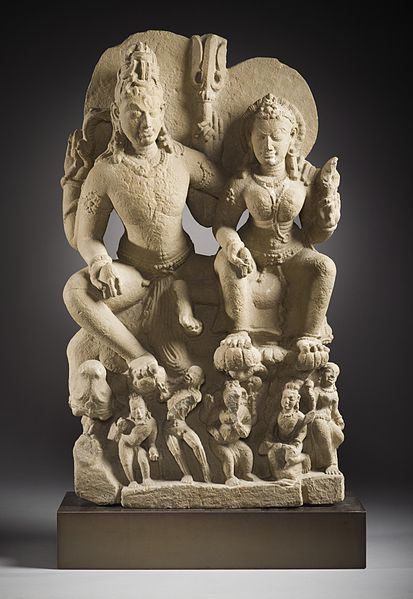
The world as forum for action is composed, essentially, of three constituent elements, which tends to manifest themselves in typical patterns of metaphoric representation. First is unexplored territory – the Great Mother, nature, creative and destructive, source and final resting place of all determinant things. Second is explored territory – the Great Father, culture, protective and tyrannical, cumulative ancestral wisdom. Third is the process that mediates between unexplored and explored territory – the Divine Son, the archetypal individual, creative exploratory Word and vengeful adversary. We are adapted to this world of divine characters, much as to the objective world. The fact of this adaptation implies that the environment is in reality a forum for action, as well as a place of things.

Unprotected exposure to unexplored territory produces fear. The individual is protected from such fear as a consequence of ritual imitation of the Great Father- as a consequence of the adoption of group identity, which restricts the meaning of things, and confers predictability on social interactions. When identification with the group is made absolute, however – when everything has to be controlled, when the unknown is no longer allowed to exist – the creative exploratory process that updates the group can no longer manifest itself. The Restriction of adaptive capacity dramatically increases the probability of social aggression.

Jordan Peterson

As Jung has stated, group identity eliminates individuality to the detriment of the individual.

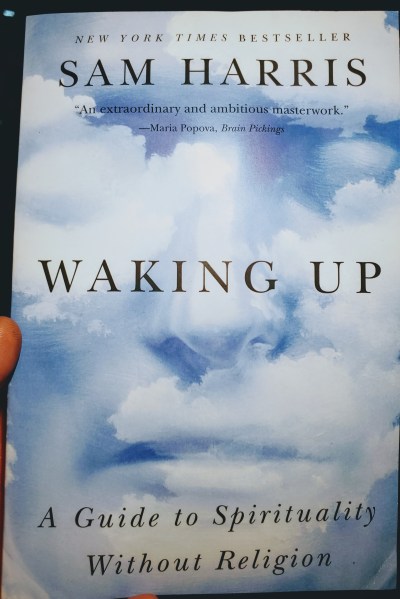
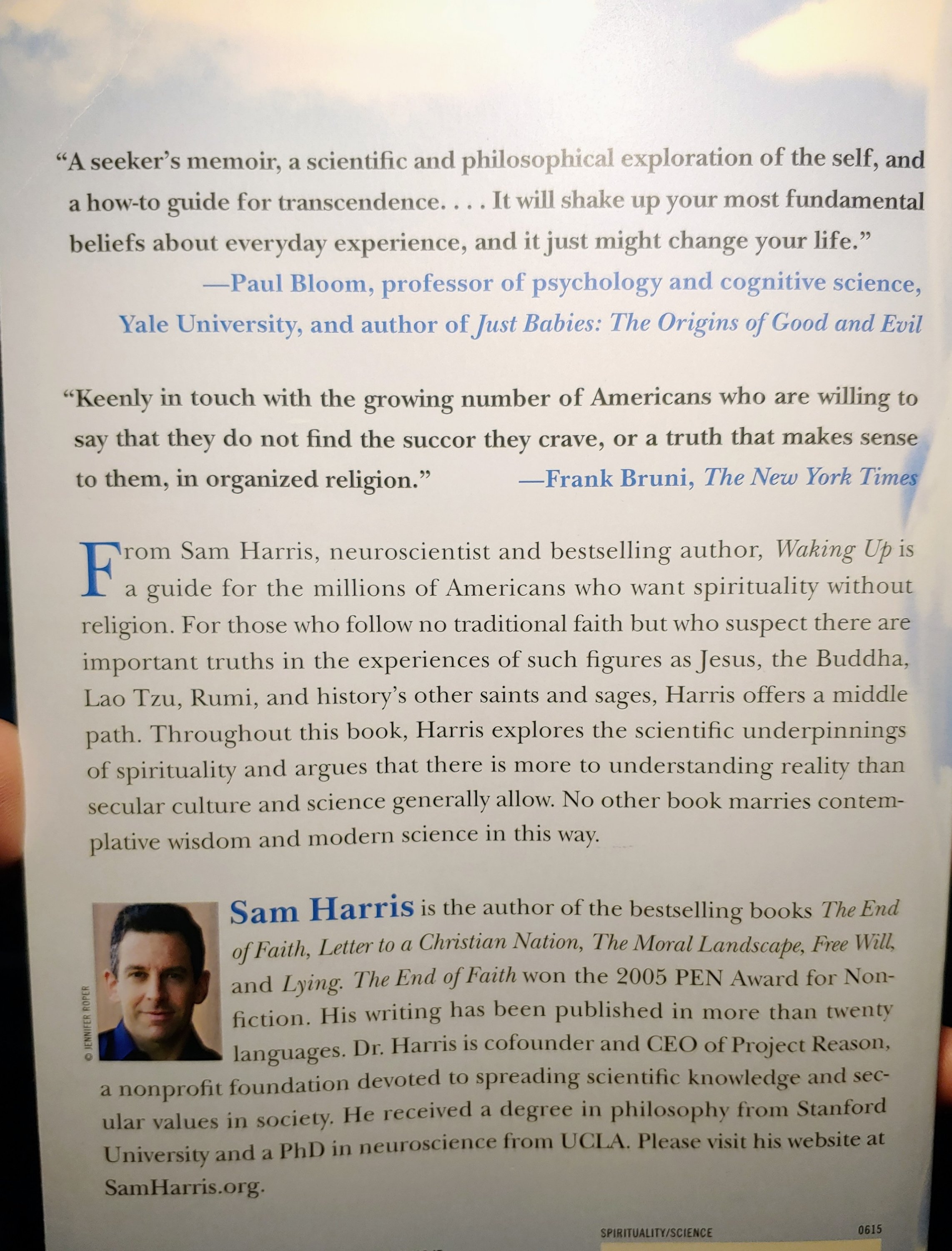
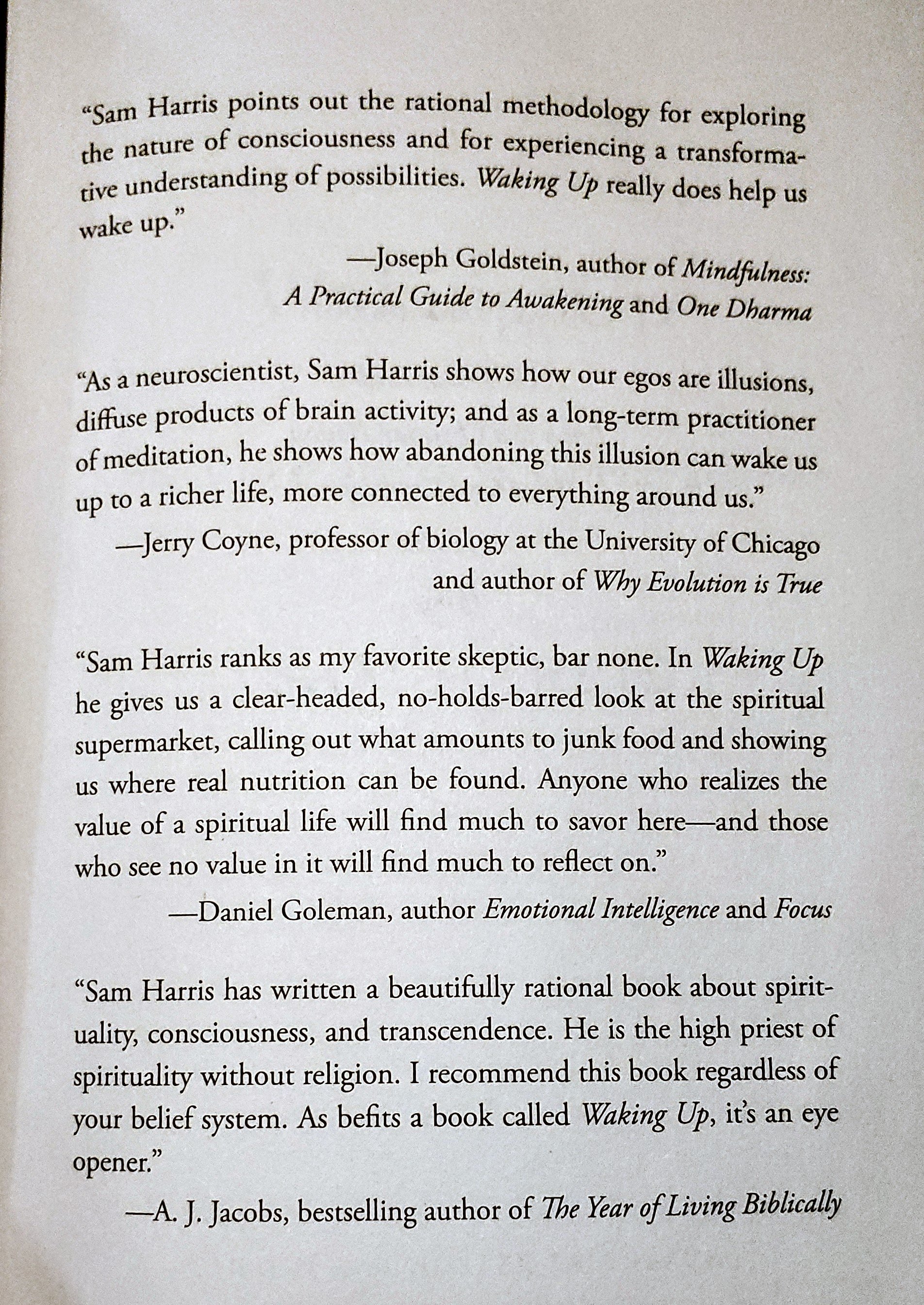
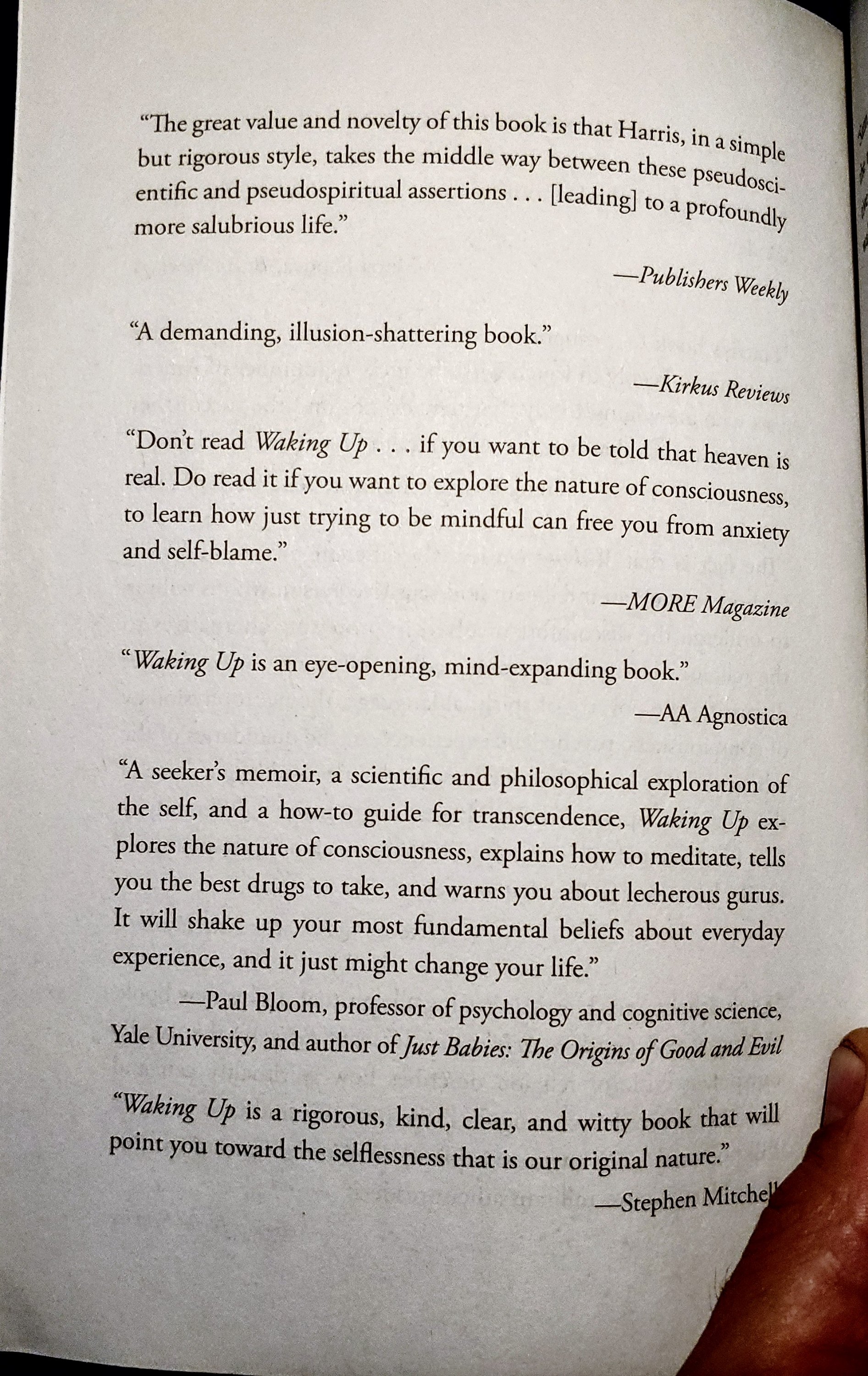
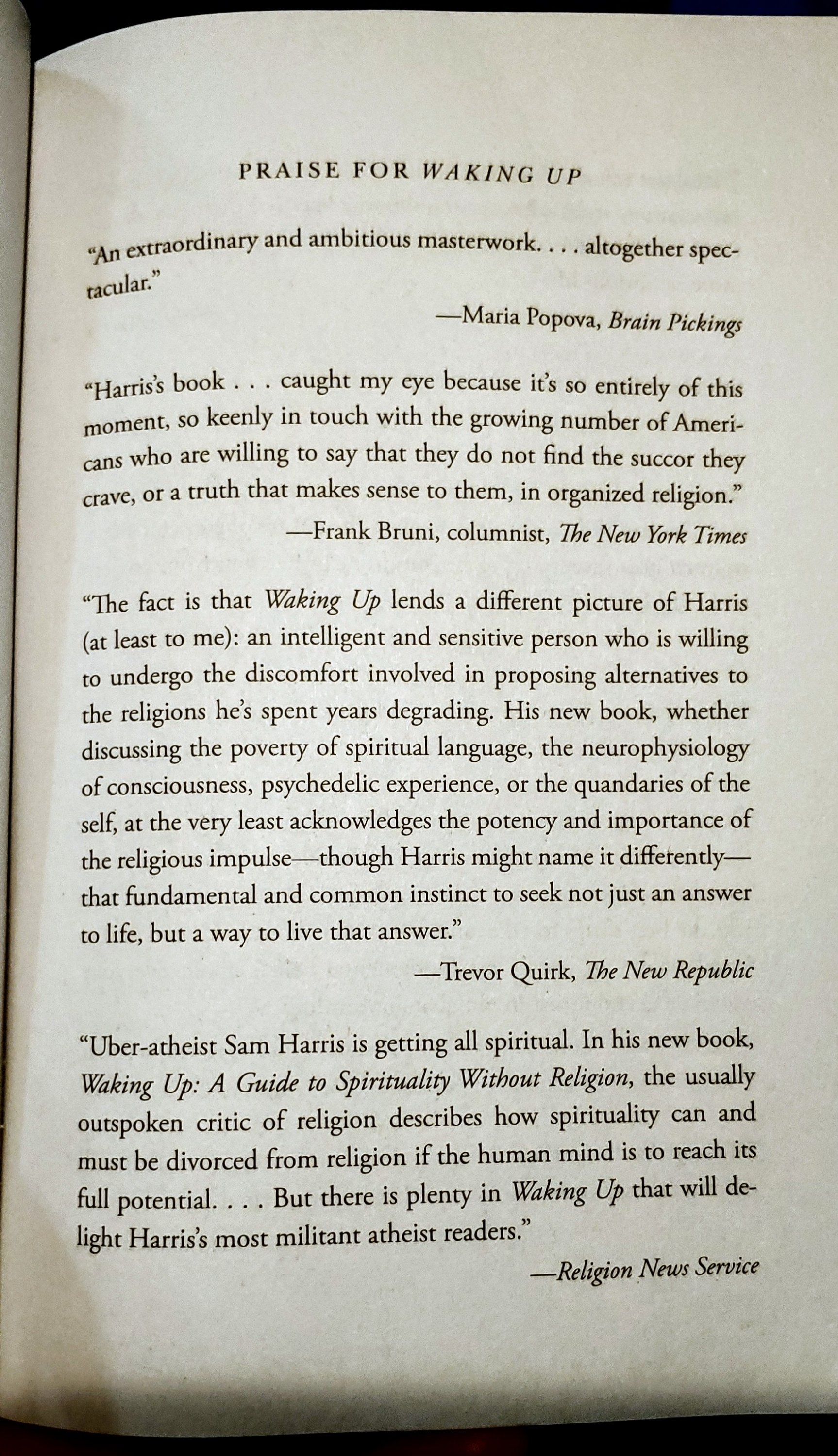
Waking Up (A Guide to Spirituality Without Religion)

In this book Sam goes into deatil on how one can have spirituality without religion. Understanding this fact, I feel, is crucial for the advancement of human kind. It’s absolutely imperative for the expansion of conciousness to seperate spirituality from religion. Most often people use religion to put a personal spiritual experience into context, though, most don’t know that religion and it’s dogmatism isn’t necessary for one to put it into context, and in certain cases is more harmful to the individual to do so. Fertile ground for a spirtual consciousness does not lie in restrictive dogmatic superstitions.

20% of Americans describe themselves as “spiritual but not religious.” Although the claim seems to annoy believers and atheists equally, separating spirituality from religion is a perfectly reasonable thing to do. It is to assert two important truths simultaneously: Our world is dangerously riven by religious doctrines that all educated people should condemn, and yet there is more to understanding the human condition than science and secular cultural generally admit. One purpose of this book is to give both these convictions intellectual and empirical support

Sam Harris

Occultism

The Occult, what is it? The only time I ever hear the term is in conspiracy videos when someone is referencing Satan/demon worship, human sacrifice, demonic rituals, and lately pedophilia. Or in the mainstream to talk about vampires or, again, satan worship. The term Occult is one of the most misunderstood and misrepresented words that people with zero knowledge of the Occult like to throw around to any ritualistic practice they deem evil. The Christian church has worked for millennia to distance themselves from the term, by using it to label anything spiritual they deem heretic and claiming none of their practices are of the occult, or have any occult origins. Their smear campaign has been so effective it is embedded into all of western thought in both religous and atheistic cirlcles.

The term is a bit vague so it can mean alot of different things, sort of like the term religion. So in simplist terms the occult as a noun is defined as: supernatural, mystical, or magical beliefs, practices, or phenomena and/or matters regarded as involving the action or influence of supernatural or supernormal powers or some secret knowledge of them. It is also used as an adjective, simply meaning: not revealed/secret, not easily apprehended/understood, not manifest or detectable by clinical methods alone, and used in astronomy/astrology to mean: hidden from view/concealed.

In none of that is occult defined as Satan worship, pedophilia, or blood rituals. If you were to define Christianity as Occult is being defined now, then Christianity would mean Jim Jones and kool-aid. Now to briefly address the word “magic”. Again, another totally loaded word that I could make another lengthy post out of, so I’ll define it as simply as possible (doing the word injustice) to not detract from this post. Magic for me is defined as: the means of infulencing/manipulating the subjective and objective world through the act of intention and concentrated will power.

So with these definitions in mind you can see how the Eucharist ritual (Christianity’s communion) is an Occult magic ritual. Many aspects of Christian belief, prayer and ritual/ceremony are of occult narure, utilizing ritual magic. So indeed many of your own beliefs are occult beliefs – whether you practice any religion or not – and are of occult nature/origin.
Native American (or any indigenous people) Shamans, Christian priests, Buddhist, Hindu, and the like prcatice occult arts.

Practically all of the philosophy I profess and all of the books I read are of the “occult”. Any spiritual leader prcatices occult arts. Tarot is occult, meditation and prayer can be ritualistic magic, anything from personal/private, all the way through to Freemason, and on up to Christian rituals are occult rituals.

So as you can see the “Occult” isn’t what you think it is and it is likely you have occult beliefs and practices. The people who throw the term around to call something foreign to them evil have, I’m sure, never truly investigated the occult, or the word wouldn’t be so stigmatized. Please use this to see the term occult as it truly is, just a loaded word that describes a “hidden” magical practice/belief that isn’t at all evil or sinister.

Social Degradation

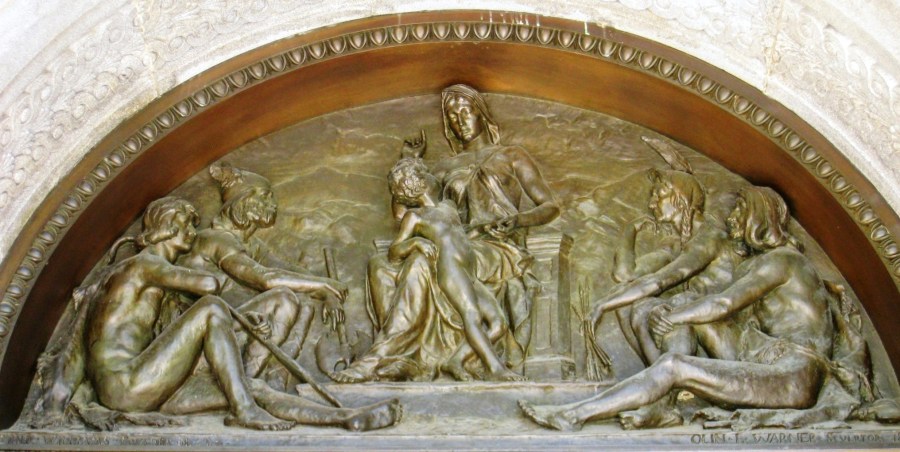
Written in 1951 but is painfully more relevant now. Paragraph 2 perfectly describes social media. Goes to show no matter what tools we have available to us, we humans constantly make the same mistakes.

With conflict the dominant keynote in modern human relationships, the peacemaker is given slight consideration. He may be branded politically as a pacifist or accused of cowardice. We have long held that it is proper to maintain belligerently and aggressively both our principles and our opinions. Failure to do so is diagnosed as a deficiency of character. In spite of this, however, the long memory of the world still honors the men of peace and those kindly sages who courageously lived and died in defense of the right to be kind.

Living as we do in a social system becoming more intense and confused everyday, we are constantly tempted to become involved in the conflicts of those around us. We are expected to take sides, to defend and offend, to argue and debate, and most of all to appear appropriately disturbed. It is a social error to be composed when others are exhausting their resources in pointless agitation. To such contestants, the peacemaker is not blessed, for he reveals a measure of self-control, which is itself disquieting to the uncontrolled.

Peacemaking is not a profession; it is an instinct, and only succeeds when it is sustained by other gentle and kindly traits of character. When calmness pervades the atmosphere, radiating from a relaxed, well poised person, it is a force to be reckoned with, but when it is demanded or required by some moralizer who knows not whereof he speaks, it has no calming influence.

Manly P. Hall

Indivisible Truth

The miracle is not accomplished by the direct search for health, but by the experience of the inflow of the presence of God. We ask not that our aches and pain shall be taken from us, but that in our hearts we shall know that faith by which all perfect works are possible. There are many weaknesses, but only one strength. There are countless infirmities, but the fact of health is indivisible from the fact of Truth. We cannot accomplish the lesser except through the greater. If we nurtured the root of the tree, we will have many flowers and fruits, but if we attempt to perfect one of the fruits the tree may perish. The cause of health is identical with the cause of peace and security and one cannot be obtained without the other.

Manly P. Hall