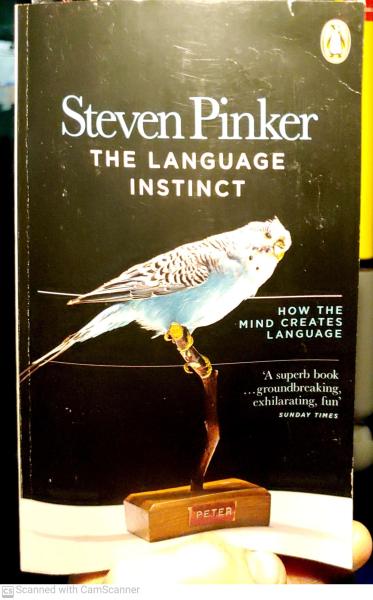
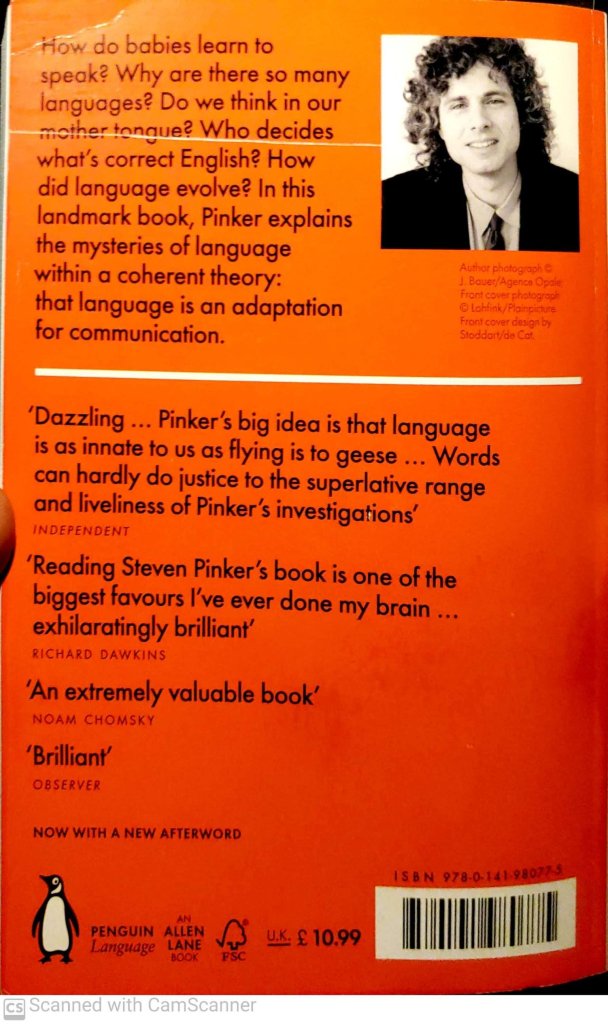
The Language Instinct

I’m reading this because I feel that a better understanding of language will help me connect dots in my research. What exactly? As of yet I do not know.

One insight so far is knowing that language/words and thought/thinking is not the same. The foundational framework of human thought is not rooted in words. Humans have a universal mentalese utilizing representations and symbols – in essence we do not think in English, Chinese, Apache, etc.

This distinction really brings in to focus why the great ancient civilizations put such an emphasis on the universal language of symbolism. Saying that “symbolism is the universal language” is not just some esoteric occult nonsense, this is rooted in a deep transcendent reality modern science is just beginning to understand.

I think it’s fruitful to consider language as an evolutionary adaption, like the eye, it’s major parts designed to carry out important functions. And Chomsky’s arguments about the nature of the language faculty are based on technical analysis of word and sentence structure, often couched in abstruse formalisms. His discussions of flesh and blood speakers are perfunctory and highly idealized. Though I do happen to agree with many of his arguments, I think that a conclusion about the mind is convincing only if many kinds of evidence can converge on it. So the story in this book is highly eclectic, ranging from how DNA builds brains to the pontifications of newspaper language columnists. The best place to begin is to ask why anyone should believe that human language is part of human biology – an instinct – at all.

Steven Pinker
Better Thinking

Reasoning aside, we know that people often acquire their beliefs about the world for reasons that are more emotional and social than strictly cognitive. Wishful thinking, self-serving bias, in-group loyalty, and frank self-deception can lead to monsters departures from the norms of rationality. Most beliefs are evaluated against a background of other beliefs and often in the context of an ideology that a person shares with others. Consequently, people are rarely aa open to revising their views as reason would seem to dictate.

There are some things that we are just naturally bad at. And a mistake people tend to make across a wide range of reasoning tasks are not mere errors; they are systematic errors that are strongly associated both within and across tasks. As one might expect, many of these errors decrease as cognitive ability increases. We also know that training, using both examples and former rules, mitigate many of these problems and can improve a person’s thinking.

On this front, the internet has simultaneously enabled two opposing influences on belief: on the one hand, it has reduced intellectual isolation by making it more difficult for people to remain ignorant of the diversity of opinion on any given subject. But it has also allowed bad ideas to flourish – as anyone with a computer and too much time on his hands can broadcast his point of view and, often enough, find an audience. So while knowledge is increasingly open source, ignorance is, too.

Sam Harris

Out-Group Hostility – In-Group Altruism

A very interesting theory to contemplate. I feel this helps make sense of our current state of tribalism and morality.

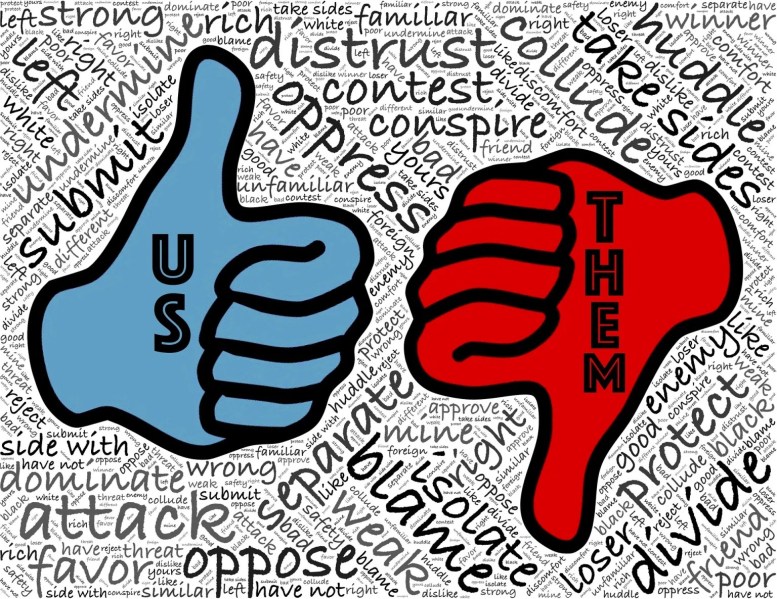
Territorial violence might have been necessary for development of altruism. The economist Samuel Bowles has argued that lethal, “out-group” hostility and “in-group” altruism are two sides of the same coin. His computer models suggest that altruism cannot emerge without some level of conflict between groups. If true, this is one of the many places where we must transcend evolutionary pressures through reason – because, barring an attack from outer space, we now lack of proper “out-group” to inspire us to further altruism.

Sam Harris

Explains why it seems that we are constantly looking for a “they”, “them”, or “other” to transgress upon, contradictory to the altruism we show “our” own group.

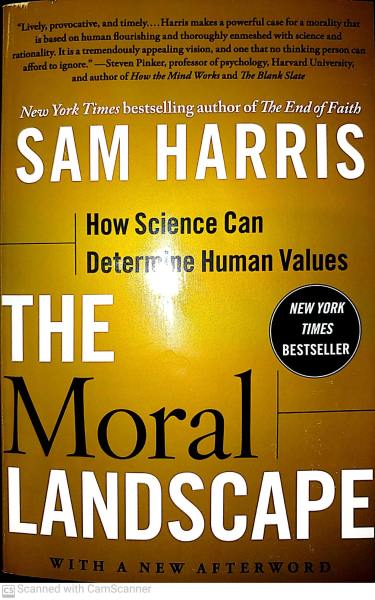
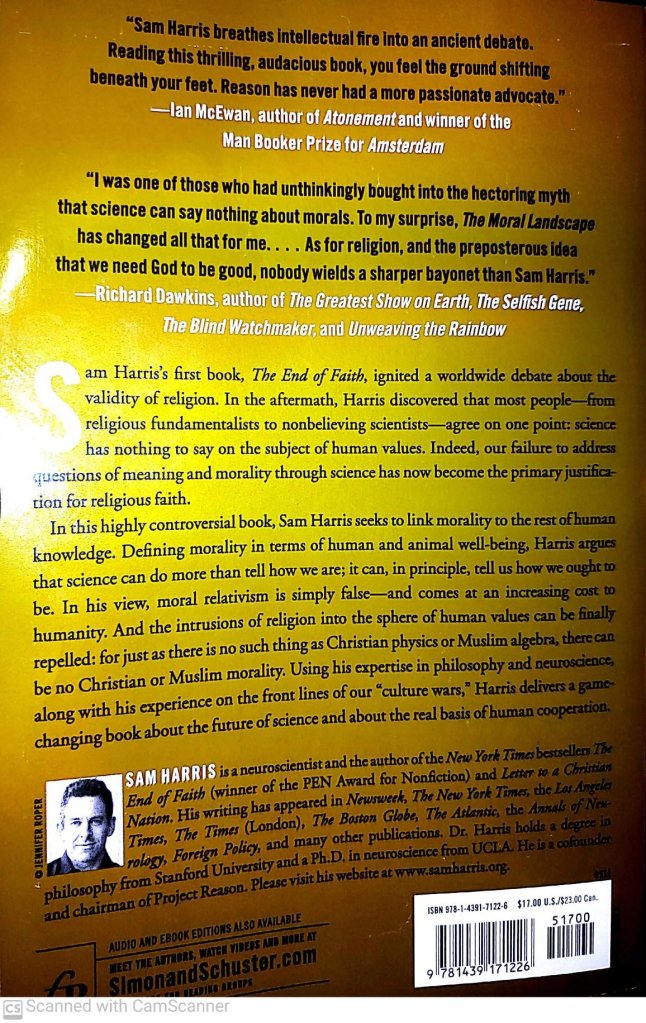
The Moral Landscape

My new book by Sam Harris

There are facts to be understood about how thoughts and intentions arise in the human brain; there are facts to be learned about how these mental states translate into behavior; there are further facts to be known about how these behaviors influence the world and the experience of other conscious beings. We will see that facts of this sort exhaust what we can reasonably mean by terms like “good” and “evil.” They will also increasingly fall within the purview of science and run far deeper than a person’s religious affiliation. Just as there is no such thing as Christian physics or Muslim algebra, we will see that there is no such thing as Christian or Muslim morality. Indeed, I will argue that morality should be considered an undeveloped branch of science.

Sam Harris

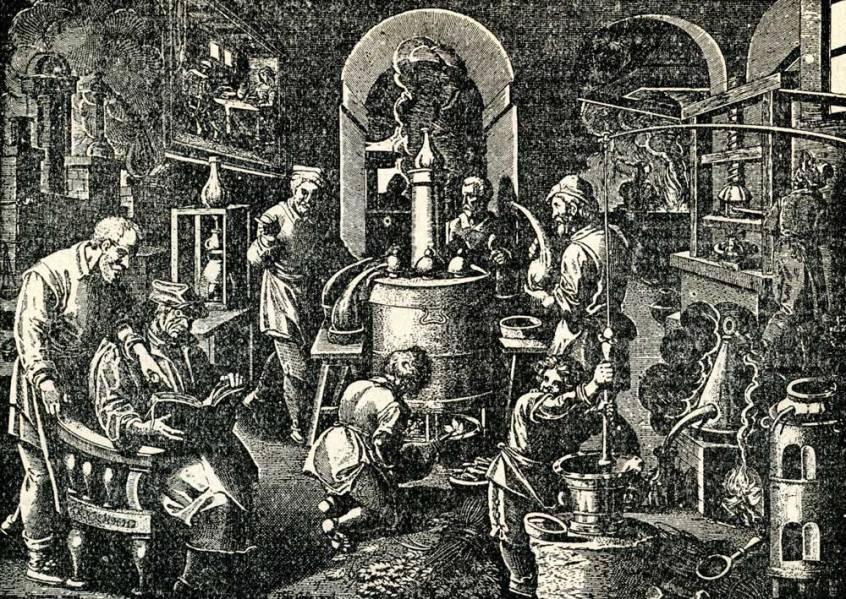
Sterilized Christianity – Alchemist Redemption

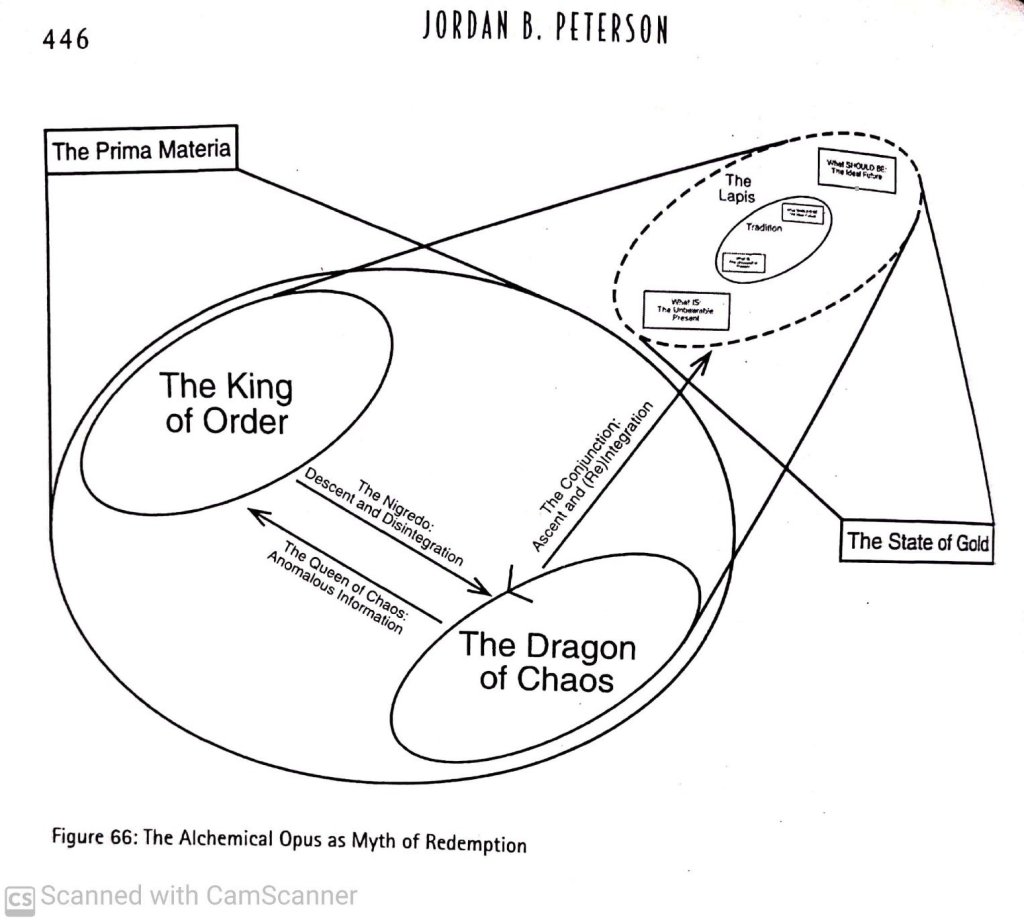
This final value, the goal of the pursuit of the alchemist, is discovery and embodiment of the meaning of life itself: integrated subjective being actively expressing its nature through manipulation of the possibilities inherent in the material / unknown world. This final goal is the production of an integrated intrapsychic condition – identical to that of the mythological hero – “acted out” in a world regarded as equivalent to self. Production of this condition – the lapis philosophorum – constitutes the antidote for the “corruption of the world,” attendant upon the Fall [attendant upon the emergence of “partial” self-consciousness.] The lapis is “agent of transformation,” equivalent to the mythological redemptive hero – able to turn “base metals into gold.” It is, as such, something more valuable than gold – just as the hero is more valuable than any of his concrete productions. The “complete” alchemical opus – with production of the lapis as goal – is presented schematically in figure 66.

Alchemy was a living myth: the myth of the individual man as redeemer. Organized Christianity had “sterilized itself,” so to speak, by insisting on the worship of some external truth as the means to salvation. The Alchemist (re)discovered the error of this presumption, and came to realize that identification with the redeemer was in fact necessary, not his worship; that myths of redemption had true power when they were incorporated, and acted out, rather than believed, in some abstract sense. This meant: to say that Christ was “the greatest man in history” – a combination of the divine and mortal – was not sufficient expression of faith. Sufficient expression meant the attempt to live out the myth of the hero, within the confines of individual personality – to voluntarily shoulder the cross of existence, to “unite the opposites” within a single breast, and to serve as active conscious mediator between the eternal generative forces of known and unknown.

Jordan Peterson

The Holy Pilgrimage

The unknown is contaminated with the psychoanalytic “unconscious,” so to speak, because everything we do not know about ourselves, and everything we have experienced and assimilated but not accommodated to, has the same affective status as everything that exists nearly as potential. All thoughts and impulses we avoid or supress, because they threaten our self conception or notion of the world – and all fantasies we experience, but do not admit to – exist in the same domain as chaos, the mother of all things, and serve to undermine our faith in our most vital presumptions. The encounter with the “unknown,” therefore, is simultaneously encounter with those aspects of ourselves heretofor defined as other (despite their indisputable “existence”). This integration means making behavioral potentialities previously disregarded available for conscious use; means (re)construction of the self model that accurately represents such potential.

The ritual of pilgrimage – the “journey to the holy city” – constitutes half ritual, half dramatic enactment of this idea. The pilgrim voluntarily places him or herself outside the protective walls of original culture and, through the difficult and demanding (actual) journey to the “unknown but holy lands,” catalyzes as psychological process of broadening, integration and maturation. It is in this manner that a true “quest” inevitably fullfills itself, even though its “final, impossible goal” (the Holy Grail, for example) may remain concretely unattained.

The necessity for experience as a precondition for wisdom may appear self-evident, once due consideration has been applied to the problem (since wisdom is obviously “derived” from experience) but the crux of the matter is that those elements of experience that foster denial or avoidance (and therefore remain unencountered or unprocessed) always border on the maddening. This is particularly true from the psychological, rather than ritual, perspective. The holy pilgrimage in its abstract or spiritual version is the journey through “elements” of experience and personal character that constitute the subjective world of experience (rather than the shared social and natural world). The inner world is divided into familiar and unknown territory, as much as the outer. Psychological purpose of the rite of passage adventure (and the reason for the popularity of such journeys, in actuality and in drama) is the development of character, in consequence of confrontation with the unknown. A “journey to the place that is most feared,” however, can be undertaken spiritually much as concretely. What “spiritually” means, however, in such a context, is a “peregrination” through the rejected, hated and violently suppressed aspects of personal experience. This is most literally a voyage to the land of the enemy – to the heart of darkness.

Jordan Peterson

Meaning of Myth

The myths of a culture are its central stories. These stories provide a dramatic record of the historically predicated transformation of human intent, and appear to exist as the episodic/semantic embodiment of history’s cumulative effect on action.

The mythical narratives that accompany retention of historically determined behavior constitute non-empirical episodic representation of that behavior and its method of establishment. Myth is purpose, coded in episodic memory. Mythic truth is information, derived from past experience – derived from past observation of behavior – relevant from the perspective of fundamental motivation and effect.

Myth simultaneously provides a record of historical essential, in terms of behavior, and programs those historical essentials. Narrative provides semantic description of action in image, back translatable into imaginary episodic events, capable of eliciting imitative behavior.

Mythic narrative offers dramatic presentation of morality, which is the study of what should be. Such narrative concerns itself with the meaning of the past, with the implications of past existence for current and future activity. This meeting constitutes the ground for the organization of behavior.

Myth has come to encapsulate and express the essential nature of the exploratory, creative, communicative psyche, as manifested in behavior, as a consequence of observation and representation of that behavior, in the temporally summed, historically determined manner beginning with imitation and ending with verbal abstraction.

Jordan Peterson

Primordial Chaos

The totality of the world, which includes the significance of experienced things, as well as the things themselves, is composed of what has been explored and rendered familiar; what has yet to be encountered, and is therefore unpredictable; and the process that mediates between the two.

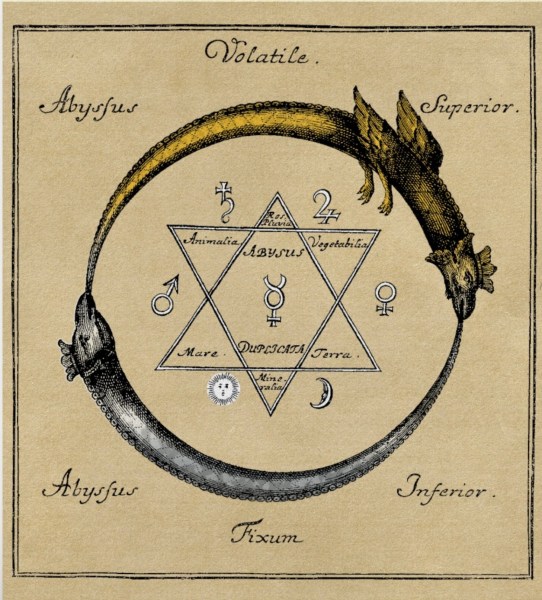
The primordial theriomorphic serpent god is endless potential; is whatever being is prior to the emergence of the capacity for experience. This potential has been represented as the self devouring dragon (most commonly) because this image aptly symbolizes the union of incommensurate opposites. Th ouroboros is simultaneously representative of two antithetical primordial elements. As a snake, the ouroboros is a creature of the ground, of matter; as a bird (a winged animal), it is a creature of the air, the sky, spirit. The ouroborus symbolizes the union of the known (associated with spirit) and unknown (associated with matter), explored and unexplored; symbolizes the juxtaposition of the “masculine” principles of security, tyranny and order with the “feminine” principles of darkness, dissolution, creativity and chaos.

Furthermore, as a snake, the ouroboros has the capacity to shed its skin – to be “reborn.” Thus, it also represents the possibility of transformation, and stands for the knower, who can transform chaos into order, and order into chaos. The Ouroboros stands for, or comprises, everything that is as of yet unencountered, prior to its differentiation as a consequence of active exploration and classification. It is a source of all information that makes up the determinant world of experience and is, simultaneously, the birthplace of the experiencing subject.

The ouroboros is one thing, as everything that has not yet been explored is one thing; it exists everywhere, and at all times. It is completely self-contained, completely self-referential: it feeds, fertilizes and engulfs itself. It unites the beginning and the end, being and becoming, in the endless circle of its existence. It serves as a symbol for the ground of reality itself. It is the “set of all things that not yet things,” the primal origin and ultimate point of return for every discriminable object and every independent subject. It serves as progenitor of all we know, all that we don’t know, and of the spirit that constitutes our capacity to know and not know. It is the mystery that constantly emerges when solutions to old problems cause new problems; is the sea of chaos surrounding man’s island of knowledge – and the source of that knowledge, as well. It is all new experience generated by time, which incessantly works to transform the temporarily predictable once again into the unknown. It has served mankind as the most ubiquitous and potent primordial gods.

Jordan Peterson

Archetypal Reality

I feel this is a very accurate description of what’s going on with our world culture currently. More specifically with politics and social justice.

The world can be validly construed as a forum for action, as well as a place of things. We describe the world as a place of things, using the formal methods of science. The techniques of narrative, however – myth, literature and drama – portray the world as a forum for action.

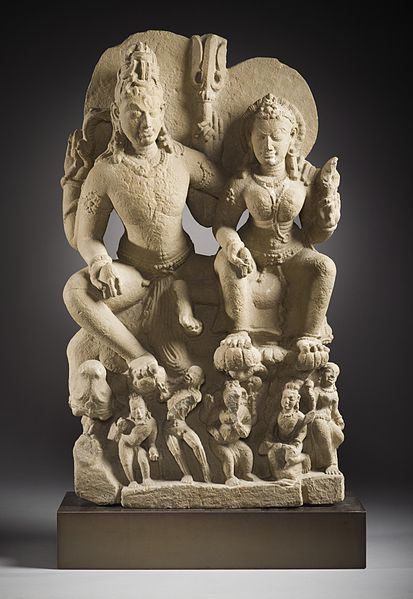
The world as forum for action is composed, essentially, of three constituent elements, which tends to manifest themselves in typical patterns of metaphoric representation. First is unexplored territory – the Great Mother, nature, creative and destructive, source and final resting place of all determinant things. Second is explored territory – the Great Father, culture, protective and tyrannical, cumulative ancestral wisdom. Third is the process that mediates between unexplored and explored territory – the Divine Son, the archetypal individual, creative exploratory Word and vengeful adversary. We are adapted to this world of divine characters, much as to the objective world. The fact of this adaptation implies that the environment is in reality a forum for action, as well as a place of things.

Unprotected exposure to unexplored territory produces fear. The individual is protected from such fear as a consequence of ritual imitation of the Great Father- as a consequence of the adoption of group identity, which restricts the meaning of things, and confers predictability on social interactions. When identification with the group is made absolute, however – when everything has to be controlled, when the unknown is no longer allowed to exist – the creative exploratory process that updates the group can no longer manifest itself. The Restriction of adaptive capacity dramatically increases the probability of social aggression.

Jordan Peterson

As Jung has stated, group identity eliminates individuality to the detriment of the individual.