It is true that Freemasonry is the parent of all religion, the original worldwide cosmic gnosis, diffused in ancient times to the uttermost ends of the earth. Freemasonry is the Pompeii of prehistoric science. All the Masonic ritual, it’s Egyptian signs, it’s Chaldean grips, it’s Sanskirt passwords, is ancient Hebrew symbols, it’s cabalistic allusions and its historical records are supremely scientific and a survival through long ages, by various underground channels, of the knowledge of the universe which was gained by Sabian astronomers from the temple tops of Chaldea, India and China and recorded by the equally learned geometers and mathematicians of the ancient Orient.
Partially what has inspired me, and led me to the path that I’m on, is watching and learning from the great Symbolists. People that can readily and pragmatically, extract meaning from, and interpret, esoteric/occult/religious symbolism, art and the like. People that approach dreams, the imagination and spirituality, with a more academic approach. I want to be able to see the world as they do, because they see the world in a completely different way than the lay person.
So one of the main focuses in my study is the development of my intuition, with the intention of being able to understand and interpret the universal language of symbolism. As you can imagine, or know from experience, this is very difficult to do. Partially because symbolism is intentionally vague, yet has to be interpreted through a certain framework. You have to train your intuition and study the roots of the symbology academically.
Starting out years ago, I wasn’t able to extract hardly any sort of meaning, from any kind of symbolism and/or art. I’d look at say a tarot card, and get nothing out of it without looking up what everything means, and relying on other people’s interpretation, which defeats the purpose of esoteric/occult symbolism.
I see a lot of people (and this was myself in the past) ask: “What does this image mean?”. No one can tell you what the image means. Esoteric and occult symbolism is intentionally vague to allow the individual to impart their own personal level of interpretation (again, still limited within a certain framework). The subtle aspects of our nature is what makes us more than who we are, more than just an animal, or just material elements in a meat sack. The things that you can’t quite explain, feelings and meanings you can’t articulate, phenomenon that can’t be explained by material science – it’s these aspects of our being that esoteric/occult symbolism is supposed to communicate with. It’s supposed to invite these divine, subtle aspects of our nature to step forward. The meaning has to come from within.
For years I have had the same problem I described above, about not being able to extract meaning from the symbolism. Finally, after many years of research, study and training, I have gotten to a point where I’m starting to intuit meaning from the art. It sort of just hit me out of no where. I guess a piece of the divine spark has touched me. So I’d like to share one of my recent interpretations. Partly because I’m very proud of myself, but majoraly because I want to let people in on how profound this ability is.
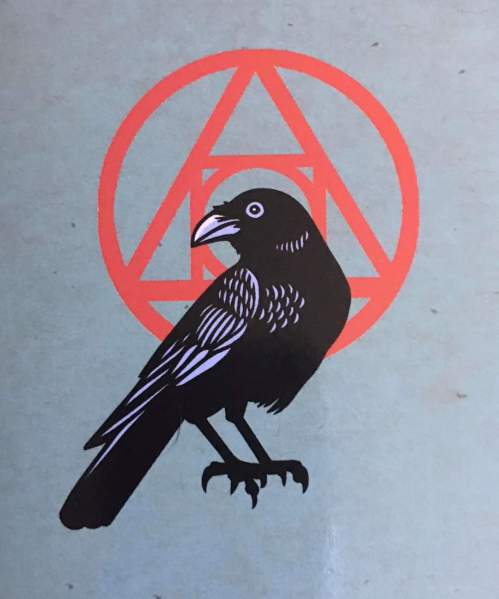
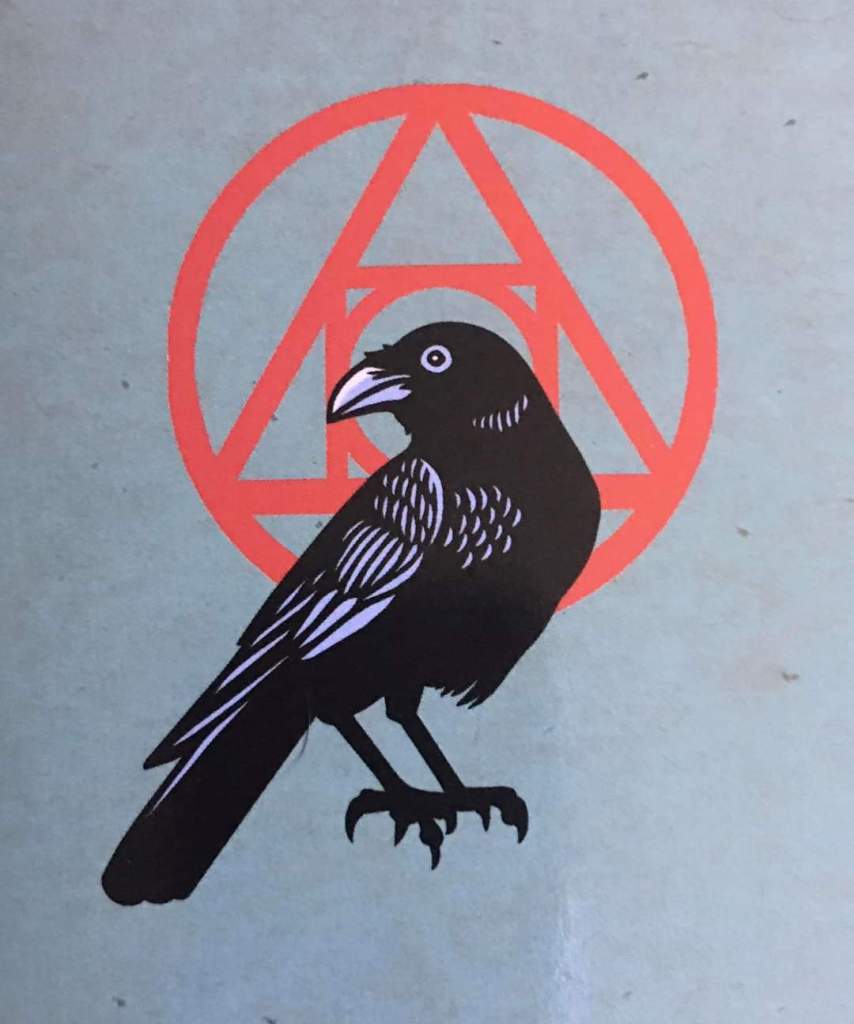
Below will be my interpretation of this image. For people not read on hermetic or qabbalistic philosophy, you’ll likely see most of this as gibberish. A quick Google search on the hermetic principle of the “All”, and a search on the alchemical “magnum opus”, will definitely help and for the most part, get you up to speed.
For me the raven represents sort of the most evolved intelligence in the bird kingdom – specifically noting how social and intuitive they are. Plus all the other traditional meanings birds imply. So in other words the most advanced state of consciousness in the bird kingdom.
Seeing the circle, encapsulated (or perhaps “nested”) in the square, the square in the triangle, and triangle in the circle, represents a totality of the structure of our material and divine constitution within the “All” (the hermetic and qabbalistic concept of the All).
I see the first circle as me (us – humans), it’s the “dot” or “point” (perhaps one individual seed of conciousness), radiating out, unfolded in its highest, most divine form, yet still encapsulated in this material realm.
The square, or us in the four fold material realm, is us realized to it’s most divine capacity, partaking or touching the higher, divine, trinitarian, ethereal realm of spirit. So that threefold aspect of divine cosmic spirit is nested within the “limitless and boundless” All (again I’m speaking in hermetic and qabbalistic terms).
So I see this image sort of as a reminder of what is possible with our “baser” self(s). The raven also intimates towards the alchemical philosophers stone or the magnum opus. A reminder that with just base elements you can create something evolved to its highest potential (ie. the raven), something that takes part in, or something that becomes divine. That with mastery over the material and spiritual realms, we can bring ourselves back to unity with the All.
But the deeper meaning this image has for me, I can’t articulate. This is why I love esoteric and occult symbolism. Partly because with just some simple symbols you can convey truths and realities that cannot be articulated. As I stated above, just as the subtle parts of the raven is what makes it divine, and the subtle parts of our nature is what makes us divine, occult symbolism speaks to that higher more ethereal parts of our nature. It stimulates and invites out our divine nature to step forward. The universal language of symbolism is a direct path to diety and brings you closer to divinity with every step. This is a Symbolist’s vision.
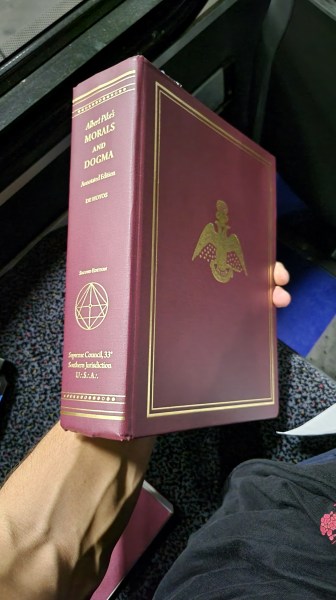
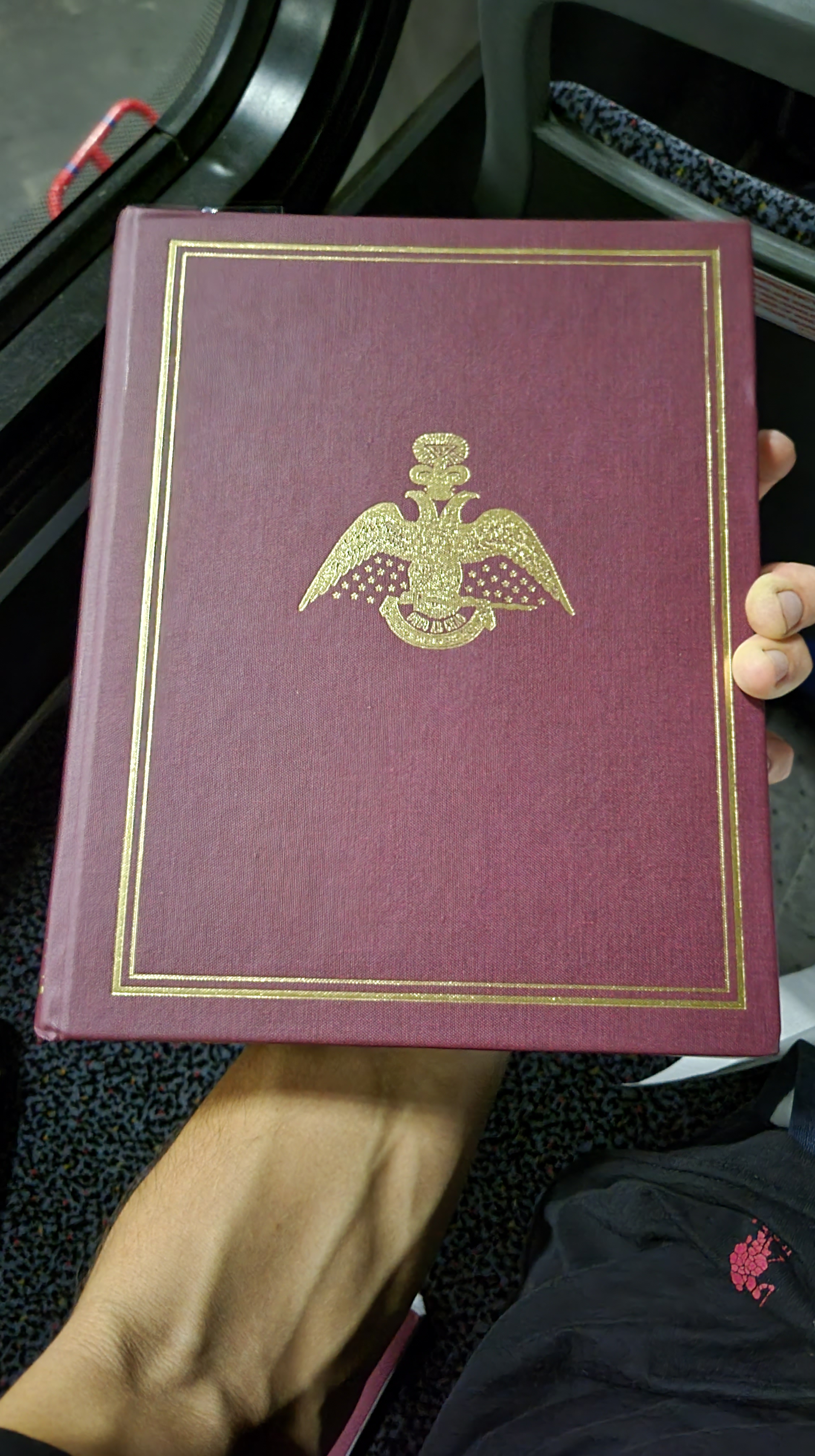
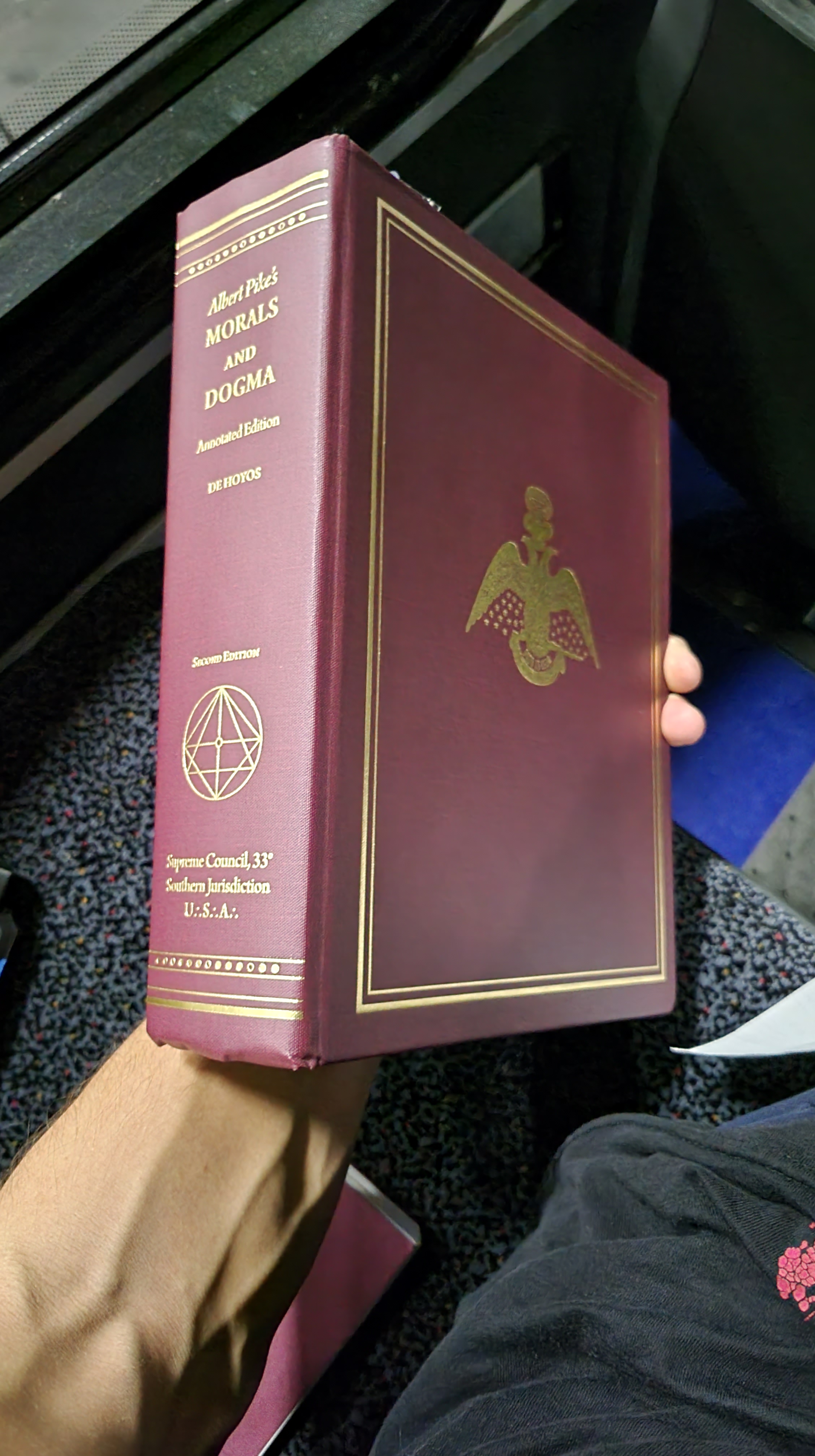
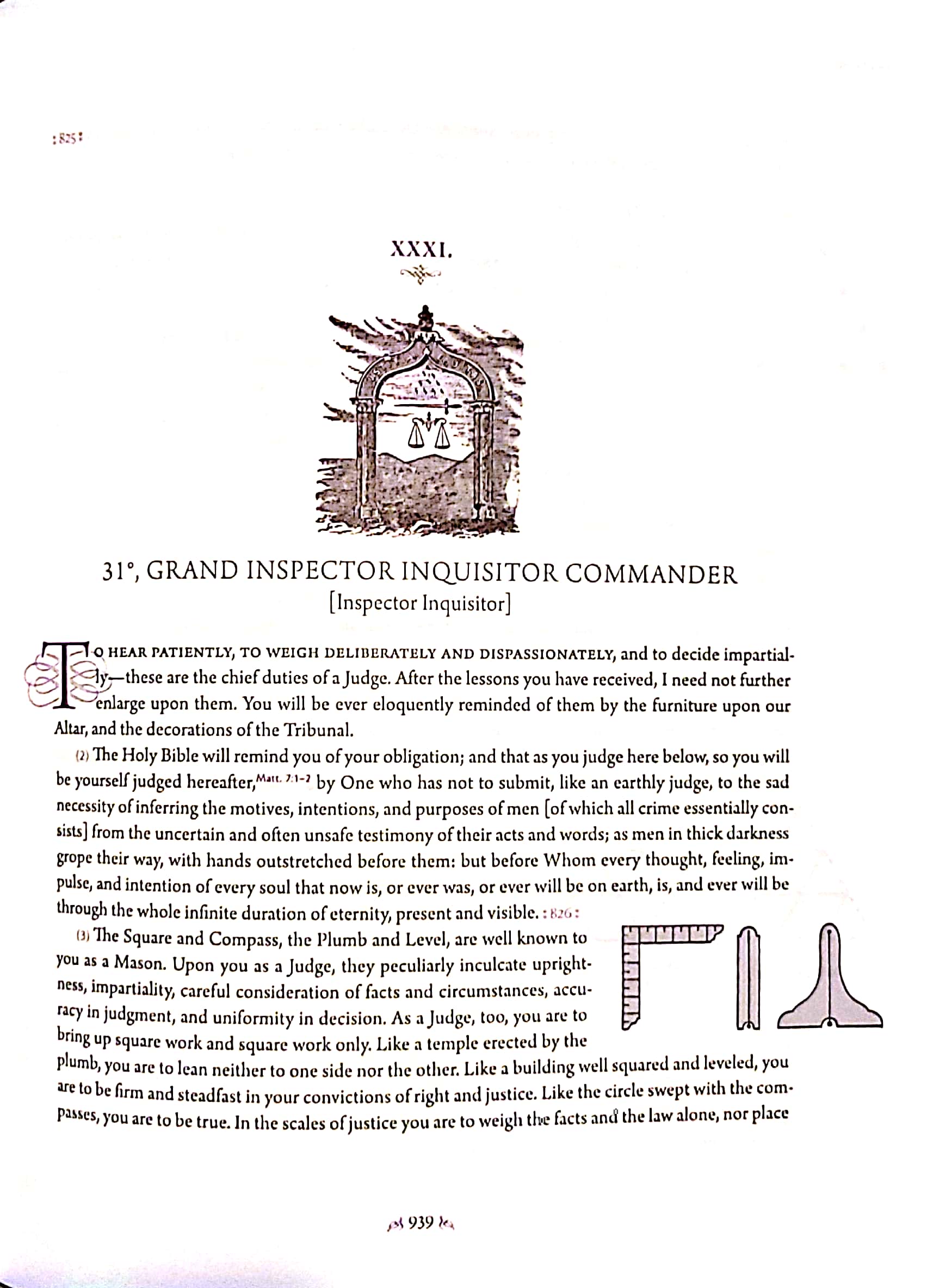
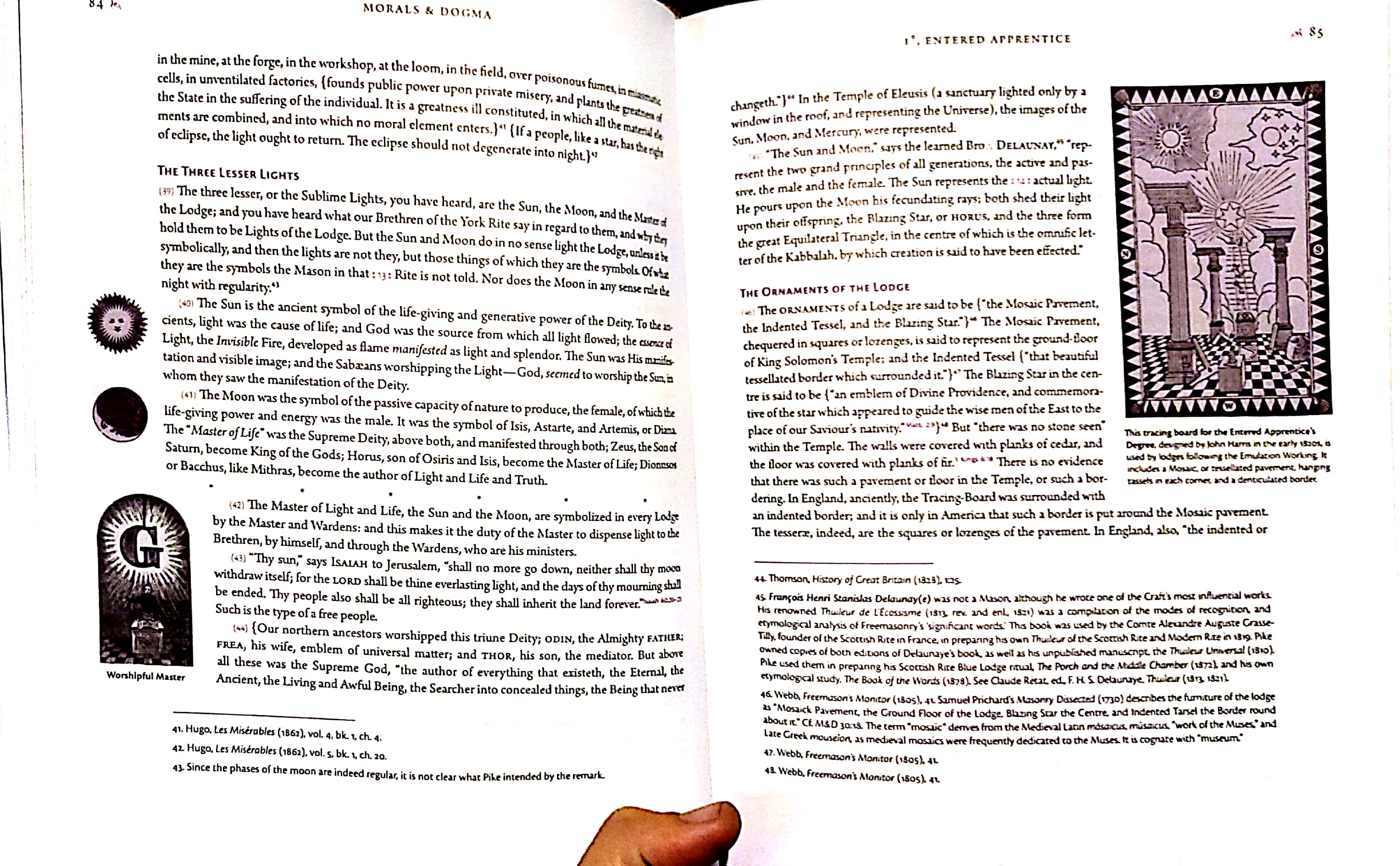
This edition of the book is of very high quality paper, illustrations, and binding.
Reading morals and dogma is an epic adventure punctuated by rhapsodic beauty and sheer confusion. Pike and his sources swing our attention to the perennial grear questions: Where do we come from? Who are we? Why are we here? What are the duties of man? What assurance do we have of a Divine Presence in the human spirit? What is the nature of reality? What ethical and moral obligations does one have to the world at large? Is there anything to be learned from human suffering? Can people of different faiths agree on a shared religious duty?
These questions, and many others, agitate the mind, and rivet our attention as much today as they did in Plato or Aristotle’s time, let alone a mere 140 years ago.
The relevance of Morals and Dogma today lies in it’s exploration of the great questions and philosophical dilemmas which have always moved humanity. Particularly for the Mason, this book serves the useful purpose of putting Masonic morality and ethics within the context of the general society. Morals and dogma bids man to think large – to cast aside the petty concerns of everyday life and to be better than he even believes he can be. As initiates of the 30 degree Knight Kadosh are aware, “Strive not to be better than others, but to be better than thyself” Is one of the duties of a Masonic philosopher.
I want to share, what I feel, is a cool piece of Freemasonic history.
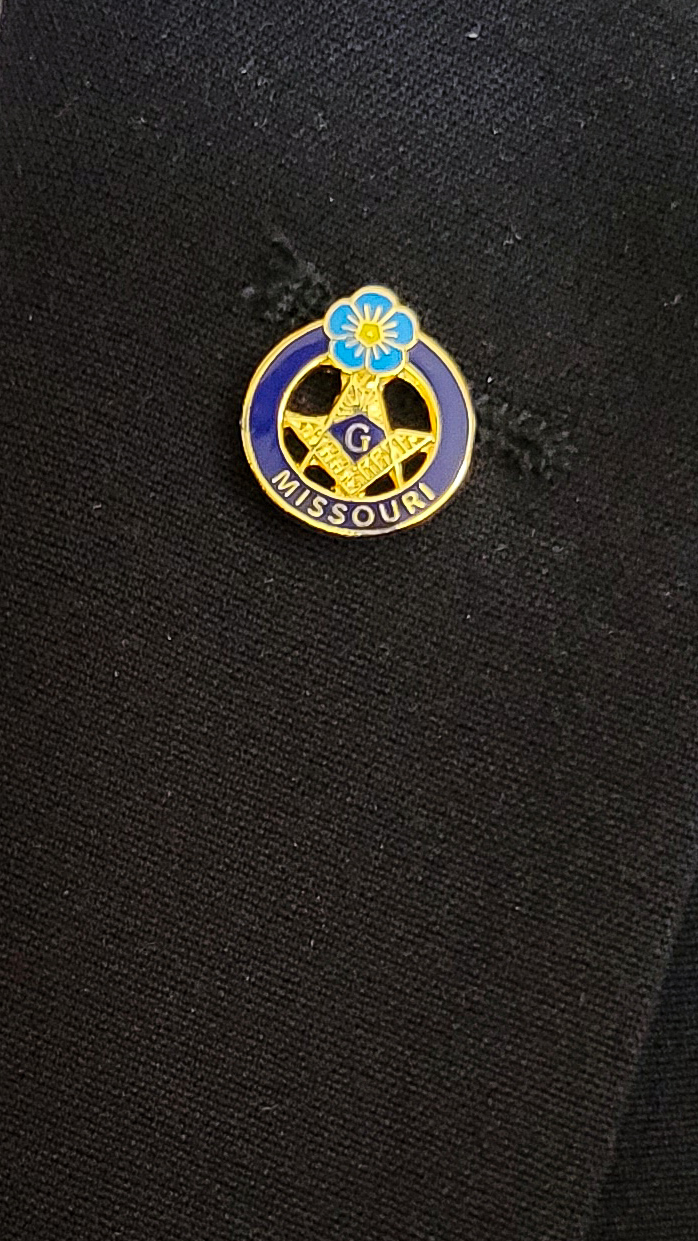
The “forget-me-not” flower (Myosotic arvensis – from the Greek, meaning “Mouse’s Ear,” after the shape of its five petals) has a pretty rich history in ancient folklore. The Germans have a few different mythological stories surrounding the origin of flower and how it got its name.
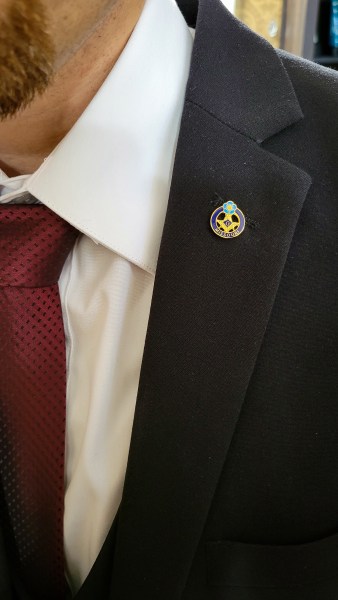
The flower – in general – symbolizes true love, enduring memory, steadfastness, and faithfulness. In 1926, after the first world war in Germany – during their economic crisis – at the German Grand Lodge annual communication, they gave its members a forget-me-not pin, to remind the brethren of their charitable obligations.
During WW2 when Hitler took power, Freemasonry was forbidden and disbanded. The Nazis even had exhibitions showing all the Masonic regalia they had seized. An estimated 80k – 200k Freemasons were executed throughout the Nazi empire.
Masonic lore tells us that during this time of Nazi control, the Grand Lodge of Germany adopted the forget-me-not, not as an emblem of charity, but as a substitute for the square and compass. It was used as a sign of recognition for the brethren, reducing their risk of exposure to the Nazis.
“During the ensuing decade of Nazi power a little blue Forget Me Not flower worn in a Brother’s lapel served as one method whereby brethren could identify each other in public and in cities and concentration camps throughout Europe. The Forget Me Not distinguished the lapels of countless brethren who staunchly refused to allow the symbolic Light of Masonry to be completely extinguished, even under penalty of death.
It was a symbol that masonry, like the flower itself, was not dead, but had merely gone dormant to weather the decade long winter. It was a symbol to its members not to forget each other, or their masonic vows, until spring had come again and the blue of masonry could flourish once more.”
“Legends like these are not told to teach us historical fact; they are meant to teach us enduring truth, or even truths, plural. And the truths of the forget-me-not are these; we must never forget our duty to the poor and distressed. We must never forget to persevere through troubled times, as light and life will always spring anew. We must never forget those who have come before us; the sacrifices they made, and the love that they shared with us. We must never forget our duty to honor their memory, and continue their legacy of brotherly love, relief, and truth. Amor fraternus, levatio, veritas. Forget. Me. Not.”
Freemasonry is different things for different men. We all join the fraternity for different reasons, nonetheless, we are all bound by one core tenet, and that is: to make good men better. We’re all here to improve ourselves individually and to help lift each other up as a group.
I became a Freemason, and maintain my position in the lodge, for a few reasons. One of the main reasons, the one that has had the most profound effect on me, is the ritual.
There really are no secrets in Freemasonry. All of their teachings are self evident, universal truths, known to all of humankind. The only thing that is “secret” (i’d say a better term is hidden, or rather, occult knowledge) about Freemasonry is how that information is taught/delivered. They do this through ritual. Most people start thinking Satan worship when they hear of occult rituals, this couldn’t be further from the truth in Freemasonry. Their rituals are basically just plays we act out and that’s how the knowledge is delivered.
As humans, we all have a part of ourselves that extends itself out to the world, in an attempt to understand the things that we don’t know. We do this in our behavior, in image, myth, story, drama, ritual, symbolism, etc..There is something very profound about ritual as a phenomenon. Evolutionarily, this is one of the most vital and essential ways we have passed down our knowledge, for 100s of 1000s (if not millions) of years. The most ancient stories we have as a species allude to this. Using the Bible for example, the biblical stories were created in part from observing each other and our behavior for millennia. They are patterns of human behavior that we observed, acted out (ritual/play/drama), then articulated in the biblical narrative. (Partly why Bible verse is used in our ritual)
Ritual is at the very core of how we evolved as a species, it cannot be stressed enough how crucial this has been for our evolution. Understanding and knowledge begin with ritual. We first act things out as human beings, behaviorally, it’s essentially just a drama/play. Understanding isn’t just knowledge, understanding means you embody the information and act it out. It’s like children playing (“rough housing”), they don’t KNOW what they’re doing conciously, they’re just acting it out, observing each others behavior (learning), then distilling that information. That’s why we are able to dance with each other, it’s just knowledge and understanding that we embody and act out.
So this process of acting things out in our environment behaviorally, observing it, then distilling that information, is a process that has taken place for millions of years (arguably since beings with nervous systems have existed). This eventually led us to a place where we could actually articulate that knowledge, like the biblical narratives. This is powerful beyond comprehension. This how we have been able to pass down information, largely un changed, for millennia. Just like you can only get certain information/knowledge from a book that you can’t get from a movie, or movie to a book, or video game to movie or book etc., ritual is unique in the information it contains and how it distills that information. Ritual being a core process for our evolutionary success, it can teach you in ways nothing else can. It is absolutely fundamental to understanding. Ritual is powerful in inarticulate ways, something you just have to experience yourself to understand. These rituals are far from being just archaic and silly superstition (as many believe).
Many people may claim to understand and know Masonic teachings, and while they are universal truths, you will never quite understand what Freemasonry is about without experiencing their rituals. One thing is for sure though, I can attest to the profundity in the Freemasonic tradition. There is also a very powerful feeling knowing that you are part of, and have gone through, the same experience as many other very influential men from the past (14 presidents included). With vague ties as far back as the ancient Egyptian temple initiations, all the way through the ancient Mystery School traditions, culminating in the Age of Enlightenment when the fraternity was founded.
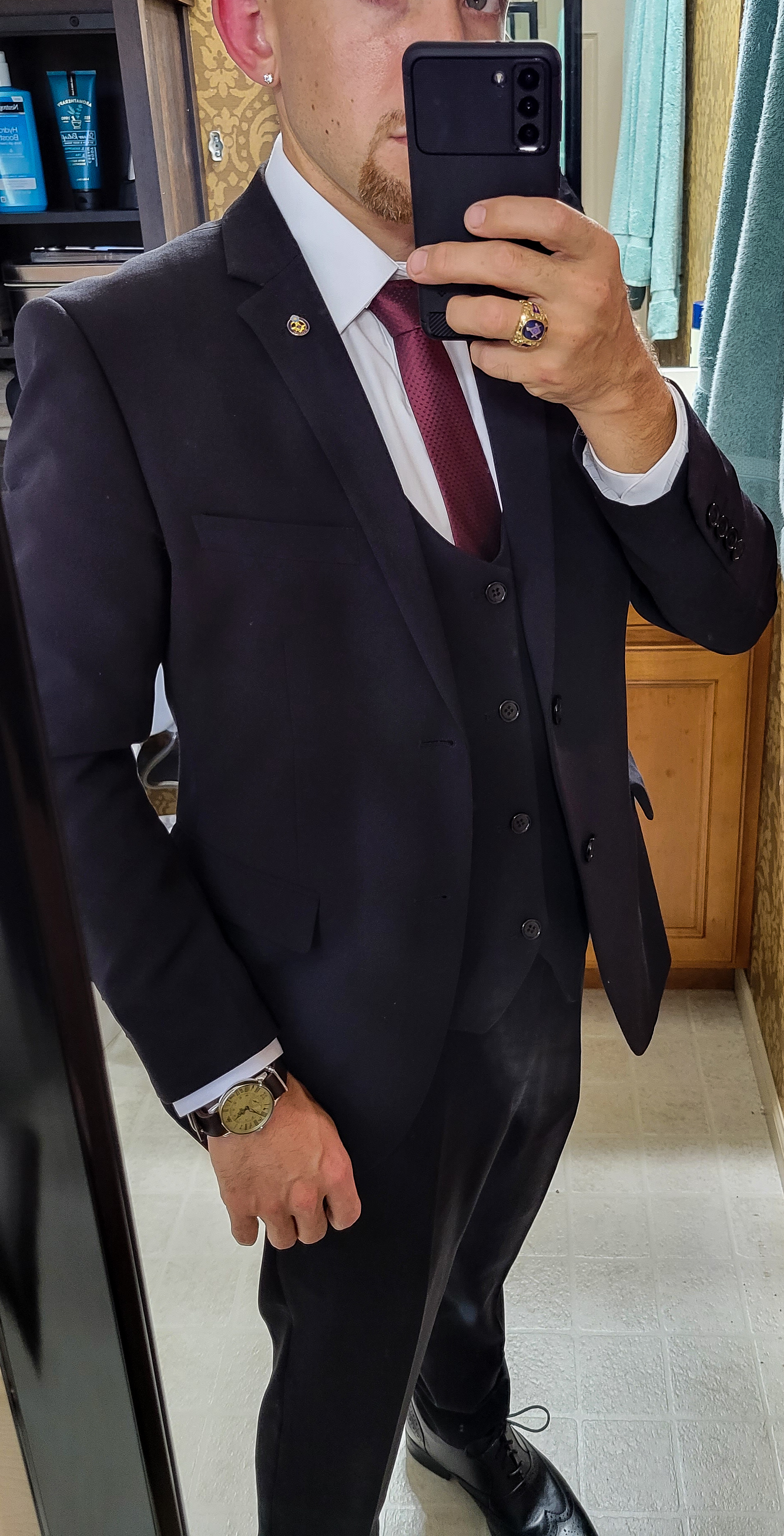
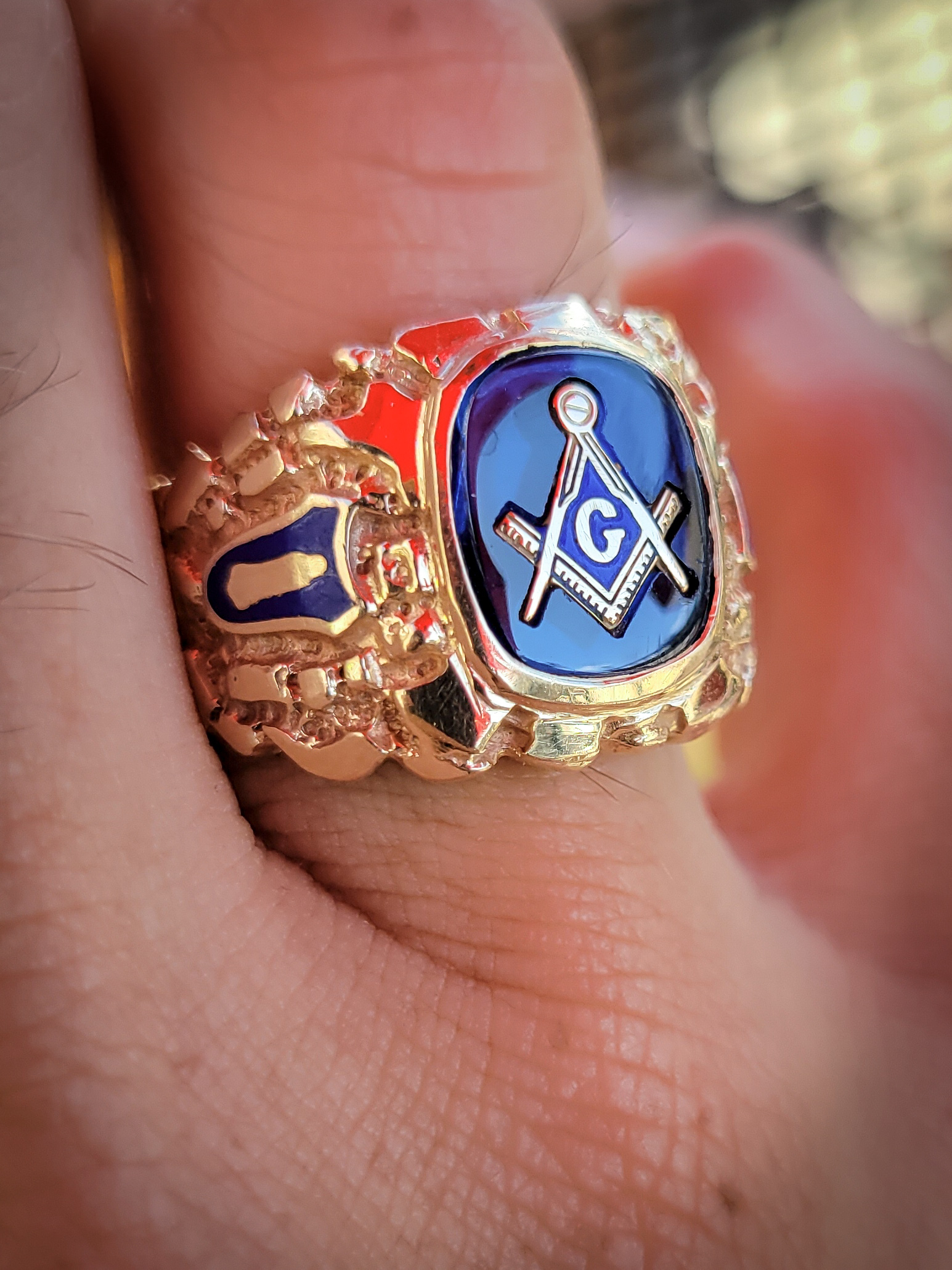
I am an initiate of the flame, a seeker of Truth, bringer of light, warden of wisdom, and a candidate that has been raised to the sublime degree of Master Mason. I have been forever changed for the better, this no doubt has been another rebirth for me, and a start to a very new and exciting chapter of my life.
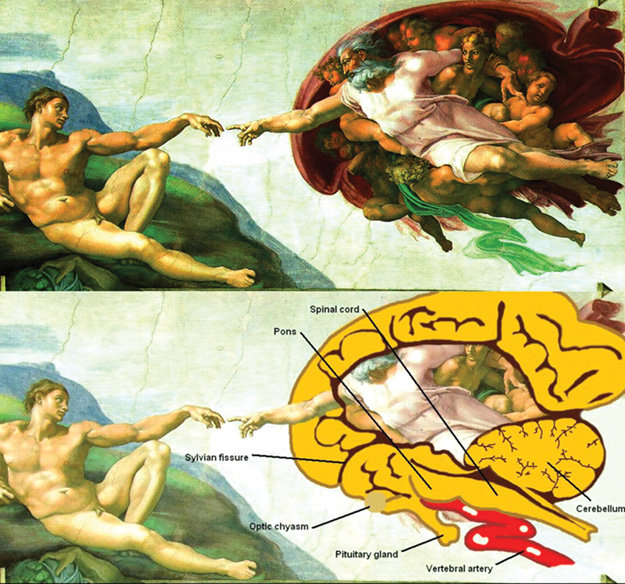
Nearly all the sacred books of the world can be traced in anatomical analogy. This is most evident in their creation myths.
Proceeding from this assumption of the first theologians that man is actually fashioned in the image of God, the initiated minds of past ages erected the stupendous structure of theology on the foundation of the human body. The religious world of today is almost totally ignorant of the fact that the science of biology is the fountainhead of its doctrines and tenants. Many of the codes and laws believed by modern divines to have been direct revelations from Divinity are in reality the fruitage of ages of patient delving into the intricacies of the human constitution and the infinite wonder is revealed by such a study.
Christianity itself may be cited as an example.
The entire New Testament is in fact an ingenuously concealed exposition of the secret processes of human regeneration. The characters so long considered as historical men and women are really the personification of certain processes which take place in the human body when man begins the task of consciously liberating himself from the bondage of ignorance and death.
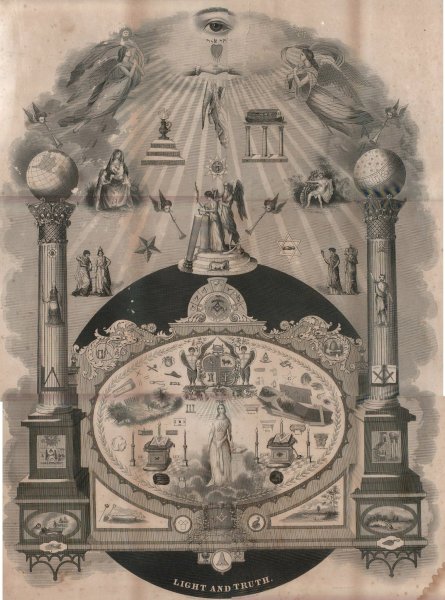
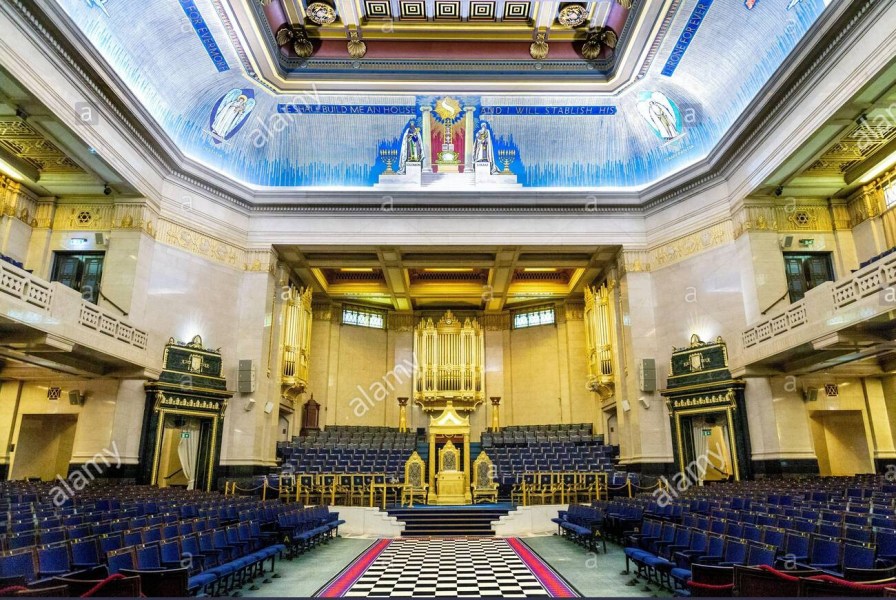
The sanctum sanctorum of Freemasonry is ornamented with the gnostic jewels of a thousand ages; its rituals ring with the divinely inspired words of seers and sages. A hundred religions have brought their gifts of wisdom to its altar; arts and sciences unnumbered have contributed to its symbolism. Freemasonry is a world-wide university, teaching the liberal arts and sciences of of the soul to all who will hearken to its words. It’s chairs are seats of learning and its pillars uphold an arch of universal education.
The philosophic power of Freemasonry lies in its symbols – it’s priceless heritage from the Mystery schools of antiquity. In a letter to Robert Freke Gould, Albert Pike writes:
“In it’s symbolism, which and it’s spirit of brotherhood are its essence, Freemasonry is more ancient than any of the world’s living religions. …”
Though Zoroaster, Hermes, Pythagoras, Plato. and Aristotle are now but dim memories in a world once rocked by the transcendency of their intellectual genius, still in the mystic temple of Freemasonry these god-men live again in their words and symbols; and the candidate, passing through the initiations, feels himself face-to-face with these illumined heirphants of days long past.
This is summary of a comment Jordan Peterson made in regards to “atheistic type people”, in so far as they have a type. He thinks that they don’t approach the Bible with enough respect. (And I’d argue most don’t even approach the Bible at all).
My approach to the Bible is the same as his, and he stated that he approaches it with the presupposition that “there’s probably more to this than I know”, and tries to understand the Bible from that perspective. Rather than to think that this is just a collection of superstitions we’ve outgrown – which isn’t a deep enough analysis.
That thinking has some truth but it doesn’t take into account the fact that the propositions in the Bible still stand at the foundation of our culture. It doesn’t take into account Nietzsche’s central concern, that if you blow out the notion of God, the entire structure crumbles. The “atheist types” haven’t wrestled with the real issues.
Watching Son(s) of Sam on Netflix got me thinking about the human desire of wanting to be a part of a group, something bigger than yourself. This seems to be neurophysiological condition hard wired into us.
The problem being, not knowing if a group, organization, religion, cult, policy or the like, is dangerous or worthy of your time/sacrifice. There is one concrete and guaranteed principle you can use as a rule to determine if any said group is dangerous and should be avoided. That is: the group should never require you to sacrifice your individuality for the group.
Any group, society, organization, etc. that requires you to sacrifice your individuality for the “greater good” of the group is doomed to fail. This is a tenet that has been potrayed in the oldest myths – from the ancient Summerian’s to the Egyptian’s all the way through the East to the West including Christianity.
The “group/society” will stagnate and die without renewal from the heroic individual. That’s what these myths are essentially saying, that we need to embody and act out being the redemptive hero to revivify the stagnated state.
The most glaring examples of groups doomed to failure, from sacrificing the individual for the group being Communism and Fascism. This is how our laws are set up in every successful civilization – that there is something redemptive and divine in every individual, as a human being. This includes murderers, rapists, or any criminal – we acknowledge that there is something divine, worthy and capable of redemption in each individual. Whether you know this and/or believe this explicitly or not, this is what we all act out.
This is how I know Freemasonry, as a fraternal organization, is founded on safe and solid principles. They explicitly state that your first priority as a Brother Mason is your “vocation”, not just meaning your work, but meaning working on yourself, as an individual, is priority #1 – then comes your brothers and the lodge (the group).
So this applies to any group (ie. LGBTQ, cars, environmental, etc.), government, organization religion, etc., etc.. While this isn’t the only criteria, it is the first and foremost, one that CANNOT be infringed upon. If they want you to sacrifice yourself for the group (whether explicitly stated or not – typically it’s not and cleverly veiled) GET OUT! It will be doomed to fail and could be dangerous.
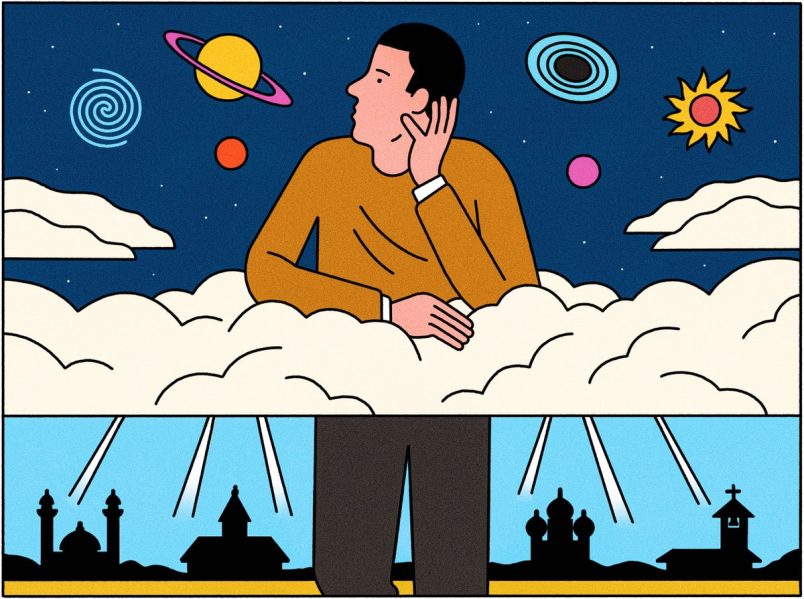
Since Neitzche, many people have agreed with the notion that God, in recent generations, is dead. Meaning we aren’t religious anymore (ie. praying, living up to a higher power, engaging in ritual, etc.) and don’t believe in “God”.
While I agree that God is dead or dying in that sense, I believe, even in this current age, that God isn’t dead, God cannot die. To the ancients God(s) existed in the sky, in the forest, rivers, oceans, in our institutions, in our hearts and in our concious minds. God is majoraly a projection of our imagination into the objective realm to help make sense of the world. This doesn’t make God any less real than if he were to actually exist as a literal being – how human behavior manifest, the cause and effects of physical reality and the end results are the same, no matter how you think of God. This is one of those metaphorical truths. Just like it will increase the well-being of an individual acting as if a gun is cocked and loaded, acting as if God was real will increase the well-being of humanity.
This quote is what provoked this post and is relevant here: “Debord also draws an equivalence between the role of mass media marketing in the present and the role of religions in the past.The spread of commodity-images by the mass media, produces “waves of enthusiasm for a given product” resulting in “moments of fervent exaltation similar to the ecstasies of the convulsions and miracles of the old religious fetishism”.”
God hasn’t died we are just worshipping new idols – God is now the new iPhone, drugs, vanity, or any unhealthy obsession/addiction. God exists in a very real – biologically concrete – way in our minds (it’s how our minds and imagination works), we cannot destroy Him so it would be wise to learn to worship Him in a healthy and constructive way, and to work towards cultivating our highest human faculties. So God isn’t dead/dying, we are only killing ourselves.



 ErudiTarot