Mystery School’s – What Are They?
“Mystery School’s, the ancient Mysteries, Mystery traditions” – what does “Mystery” mean, and why is it sometimes capitalized?

I had the question myself the first time I heard the term. I use the term often when speaking about Freemasonry and it’s a term you’ll see often when studying esoteric/occult teachings. It’s definition is quite vast and can’t really be articulated, but I’ll attempt to be as succinct as possible here, with a few quotes to aid in understanding.

Taken from Wiki:
“Mystery religions, mystery cults, sacred mysteries or simply mysteries, were religious schools of the Greco-Roman world for which participation was reserved to initiates (mystai). The main characterization of this religion is the secrecy associated with the particulars of the initiation and the ritual practice, which may not be revealed to outsiders.”

“A ‘mystery’, as it was originally defined in ancient Greece and used in the Orphic and Eleusinian mystery schools, is a type of divine revelation that can only be conveyed by experience and is incomprehensible to reason. The revelation initiates or begins a cognitive change in the recipient – also known as the initiate – that alters the way he or she sees and interacts with the world. It is not based on information or even feelings and therefore, it cannot be put into words.” – Kirk C. White

Simply put, what all Mystery schools have in common, is that they just offer a circumstance dedicated to giving the necessary space one needs to start to understand who they really are, for one to discover their real Self. So it’s the study of the Self, as an individual endeavor, and cannot be learnt/learned from anything/anyone outside of yourself.

Some of the documented, original, most ancient Mystery School’s that some may know are the Greco-Roman Mysteries (ie. Eleusinian, Samothracian, Mithriac, Dionysian, etc.)

Historically, “Their primary mission was to protect and preserve the ancient systems of enlightenment, healing, manifestation, transmutation and transformation so that they can be continually used by humanity for its collective progression. Mystery School teachings are imparted by an oral tradition. Rooted in shamanic and mystic ways of wisdom, these teachings are handed down unbroken from teacher to student in an unbroken lineage that has withstood the test of time. … To understand GOD, we must first understand ourselves who were made in their image. Mystery schools exist to empower us to ‘Know Thyself’.

As you can see, the term Mystery, when used to speak about the ancient tradition of the Mystery School’s, is not defined as most people use the word ‘mystery’ today.
Hopefully this helps one to understand what the ancient Mysteries are and what the Mystery School’s impart. But like I stated above, the “Mysteries” can only be known and felt by the individual. No one can explain to you what it is. You have to have direct contact with diety to truly understand.

Opulence

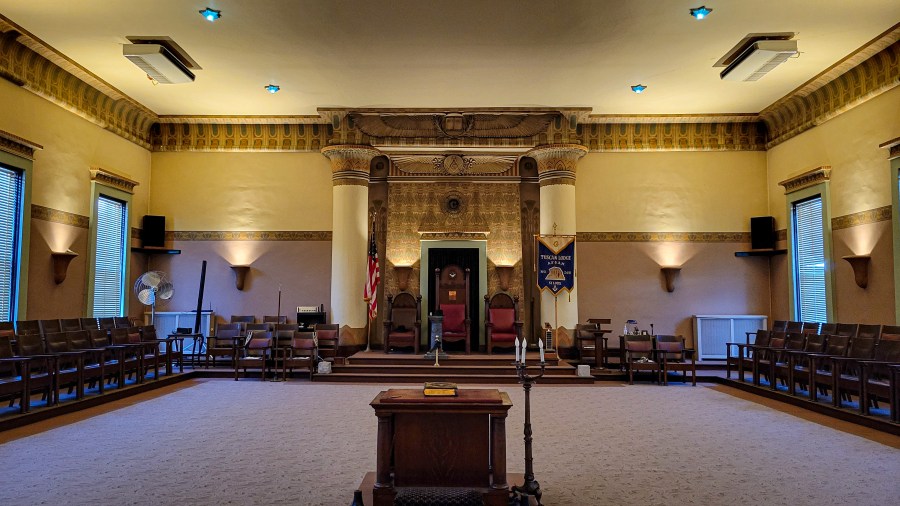
The Freemasonic ritual is intended to be a spiritually transformative experience. The initiatic aspect of Freemasonry is “intended to actually change the candidate; a rebirth with a new cognitive frame that allows him to see that he could not before – to behold the ‘mysteries’ of Freemasonry and not just the secrets.”

W.L. Wilmhurst writes:
“The purpose of initiation may be defined as follows: – it is to stimulate and awaken the candidate to direct cognition and irrefutable demonstration of facts and truths of his own being about which previously he has been either wholly ignorant or only notionally informed; It is to bring him into direct conscious contact with the Realities underlying the surface images of things, so that, instead of holding merely beliefs or opinions about himself, the universe and God, he is directly and convincingly confronted with truth itself; And finally it is to move him to become the Good and the Truth revealed to him by identifying himself with it.”

Part of how we make good men better is by this process of initiation. Which, when done right, fundamentally changes the way our brothers see, think, and act in the world. Mircea Eliade has this to say about the initiation process: “…the novice emerges from the ordeal endowed with a totally different being from that which he possessed before his initiation; he has become another.”

This is what happened to me when I was Initiated, Passed, and Raised through the fraternity. This is the main reason I stay active in the lodge, because this was so transformative and important to me. So now I am paying it forward to give new canindates the same experience. Because without me, new, and veteran Masons conferring these rituals, Freemasonry dies.

I get to take part in these initiations on a regular basis. I regularly have new canindates personally thank me and tell me that I helped in spiritually transforming them (since I typically perform very critical and involved roles) – as my brothers did for me when I was a new canindate. I’ve seen the transformations, sometimes even the very moment of epiphany.

This brings me a level of joy that I never knew existed. My life has never been more meaningful. I have never had so much direction, drive, and determination. I have never felt so powerful and strong. I have never been so happy. Words cannot convey my feelings. At the very least, all I can say is that all these feelings are felt with an intensity I never knew existed.

I now know the reason the Mystery School tradition has been passed down for 1000s of years. And I couldn’t be more honored to keep it alive and well.

Art – The Foundation of the Process by Which We Unite Ourselves Psychologically

Making something beautiful is difficult, but it is amazingly worthwhile. If you learn to make something in your life truly beautiful – even one thing – then you have established a relationship with beauty. From there you can begin to expand that relationship out into other elements of your life and the world. That is an invitation to the divine. That is the reconnection with the immortality of childhood, and the true beauty and majesty of the Being you can no longer see. You must be daring to try that.

If you study art (and literature anf the humanities), you do it so that you can familiarize yourself with the collected wisdom of our civilization. This is a very good idea – a veritable necessity – because people have been working out how to live for a very long time. What they have produced is a strange but also rich beyond comparison, so why not use it as a guide? Your vision will be grander and your plans more comprehensive. You will consider other people more intelligently and completely. You will take care of yourself more effectively. You will understand the present more profoundly, rooted as it is in the past, and you will come to conclusions much more carefully. You will come to treat the future, as well, as a more concrete reality (because you will have developed some true sense of time) and be less likely to sacrifice it to impulsive pleasure.  You will develop some depth, gravitas, and true thoughtfulness. You will speak more precisely, and other people will become more likely to listen to and cooperate productively with you, as you will with them. You will become more your own person, and less a dull and hapless tool of peer pressure, vogue, fad, and ideology.

Buy a piece of art. Find one that speaks to you and make the purchase. If it is a genuine artistic production, it will invade your life and change it. A real piece of art is a window into the transcendent, and you need that in your life, because you are finite and limited and bounded by your ignorance. Unless you can make a connection to the transcendent, you will not have the strength to prevail when the challenges of life become daunting. You need to establish a link with what is beyond you, like a man overboard in high seas requires a life preserver, and the invitation of beauty into your life is one means by which that may be accomplished.

It is for such reasons that we need to understand the rule of art, and stop thinking about it as an option, or a luxury, or worse, an affectation. Art is the bedrock of culture itself. It is the foundation of the process by which we unite ourselves psychologically, and come to see established productive peace with others. As it is said, “Man shall not live by bread alone”. That is exactly right. We cannot live without some connection to the divine – and beauty is divine – because in its absence life is too short, too dismal, and too tragic. And we must be sharp and awake and prepared so that we can strive properly, and orient the world properly, and not destroy things, including ourselves – and beauty can help us appreciate the wonder of Being and motivate us to seek gratitude when we might otherwise be prone to destructive resentment.

Jordan Peterson

A Symbolist’s Vision

Partially what has inspired me, and led me to the path that I’m on, is watching and learning from the great Symbolists. People that can readily and pragmatically, extract meaning from, and interpret, esoteric/occult/religious symbolism, art and the like. People that approach dreams, the imagination and spirituality, with a more academic approach. I want to be able to see the world as they do, because they see the world in a completely different way than the lay person.

So one of the main focuses in my study is the development of my intuition, with the intention of being able to understand and interpret the universal language of symbolism. As you can imagine, or know from experience, this is very difficult to do. Partially because symbolism is intentionally vague, yet has to be interpreted through a certain framework. You have to train your intuition and study the roots of the symbology academically.

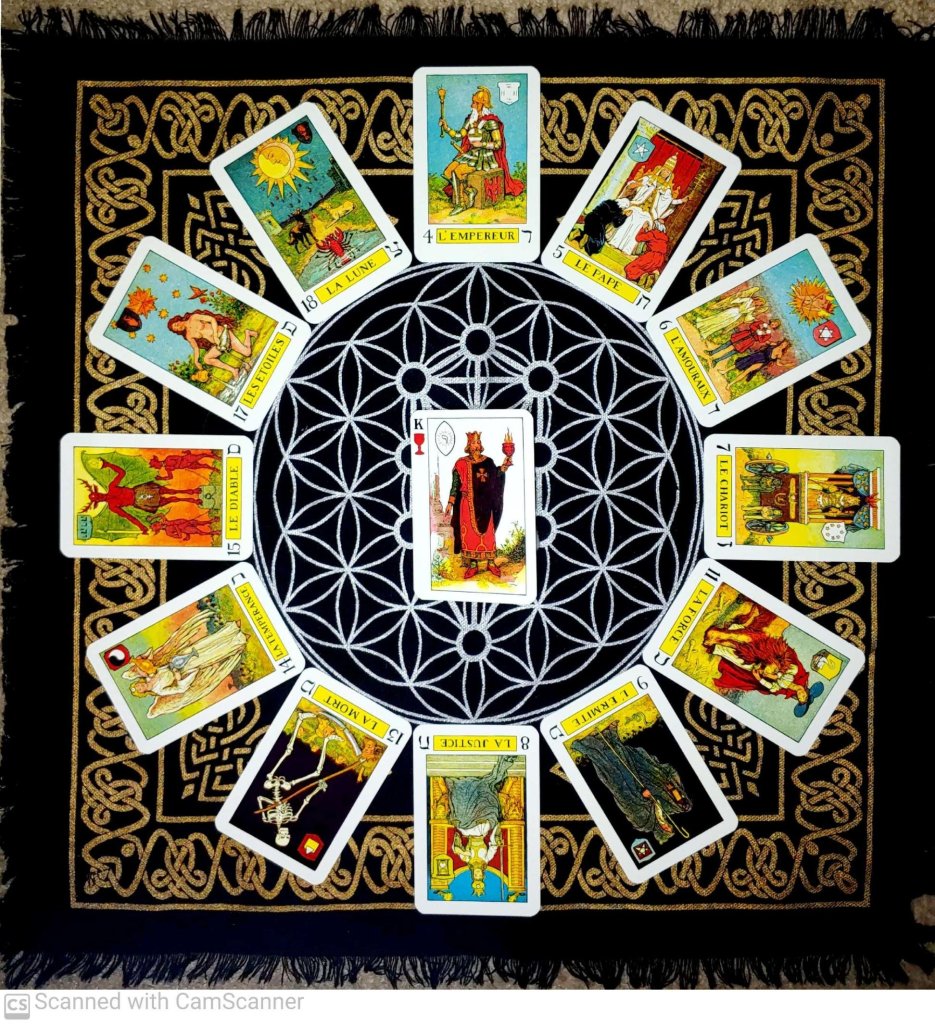
Starting out years ago, I wasn’t able to extract hardly any sort of meaning, from any kind of symbolism and/or art. I’d look at say a tarot card, and get nothing out of it without looking up what everything means, and relying on other people’s interpretation, which defeats the purpose of esoteric/occult symbolism.

I see a lot of people (and this was myself in the past) ask: “What does this image mean?”. No one can tell you what the image means. Esoteric and occult symbolism is intentionally vague to allow the individual to impart their own personal level of interpretation (again, still limited within a certain framework). The subtle aspects of our nature is what makes us more than who we are, more than just an animal, or just material elements in a meat sack. The things that you can’t quite explain, feelings and meanings you can’t articulate, phenomenon that can’t be explained by material science – it’s these aspects of our being that esoteric/occult symbolism is supposed to communicate with. It’s supposed to invite these divine, subtle aspects of our nature to step forward. The meaning has to come from within.

For years I have had the same problem I described above, about not being able to extract meaning from the symbolism. Finally, after many years of research, study and training, I have gotten to a point where I’m starting to intuit meaning from the art. It sort of just hit me out of no where. I guess a piece of the divine spark has touched me. So I’d like to share one of my recent interpretations. Partly because I’m very proud of myself, but majoraly because I want to let people in on how profound this ability is.

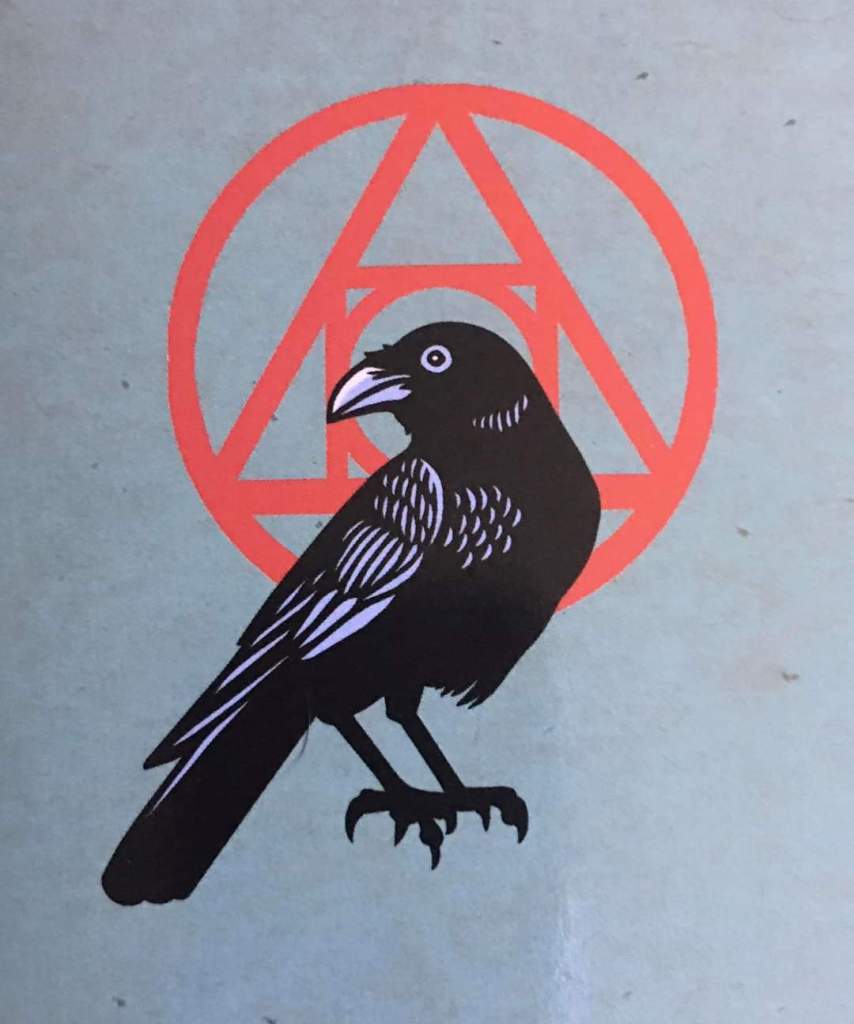
Below will be my interpretation of this image. For people not read on hermetic or qabbalistic philosophy, you’ll likely see most of this as gibberish. A quick Google search on the hermetic principle of the “All”, and a search on the alchemical “magnum opus”, will definitely help and for the most part, get you up to speed.

For me the raven represents sort of the most evolved intelligence in the bird kingdom – specifically noting how social and intuitive they are. Plus all the other traditional meanings birds imply. So in other words the most advanced state of consciousness in the bird kingdom.

Seeing the circle, encapsulated (or perhaps “nested”) in the square, the square in the triangle, and triangle in the circle, represents a totality of the structure of our material and divine constitution within the “All” (the hermetic and qabbalistic concept of the All).

I see the first circle as me (us – humans), it’s the “dot” or “point” (perhaps one individual seed of conciousness), radiating out, unfolded in its highest, most divine form, yet still encapsulated in this material realm.

The square, or us in the four fold material realm, is us realized to it’s most divine capacity, partaking or touching the higher, divine, trinitarian, ethereal realm of spirit.
So that threefold aspect of divine cosmic spirit is nested within the “limitless and boundless” All (again I’m speaking in hermetic and qabbalistic terms).

So I see this image sort of as a reminder of what is possible with our “baser” self(s). The raven also intimates towards the alchemical philosophers stone or the magnum opus. A reminder that with just base elements you can create something evolved to its highest potential (ie. the raven), something that takes part in, or something that becomes divine. That with mastery over the material and spiritual realms, we can bring ourselves back to unity with the All.

But the deeper meaning this image has for me, I can’t articulate. This is why I love esoteric and occult symbolism. Partly because with just some simple symbols you can convey truths and realities that cannot be articulated. As I stated above, just as the subtle parts of the raven is what makes it divine, and the subtle parts of our nature is what makes us divine, occult symbolism speaks to that higher more ethereal parts of our nature. It stimulates and invites out our divine nature to step forward. The universal language of symbolism is a direct path to diety and brings you closer to divinity with every step. This is a Symbolist’s vision.

The Divine Power

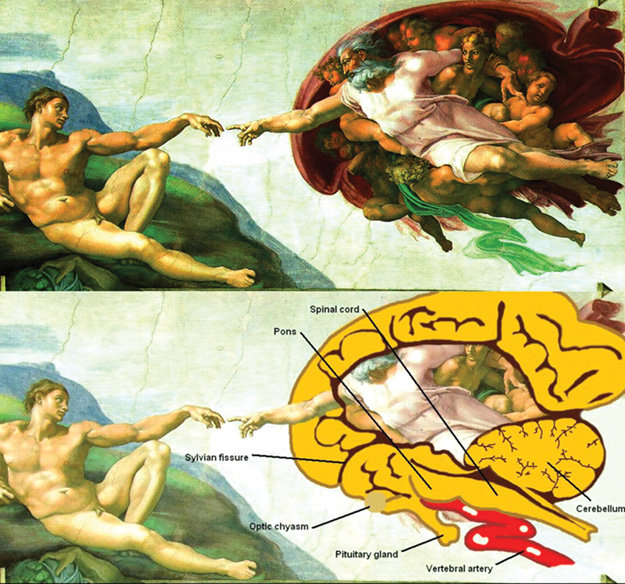
Nearly all the sacred books of the world can be traced in anatomical analogy. This is most evident in their creation myths.

Proceeding from this assumption of the first theologians that man is actually fashioned in the image of God, the initiated minds of past ages erected the stupendous structure of theology on the foundation of the human body. The religious world of today is almost totally ignorant of the fact that the science of biology is the fountainhead of its doctrines and tenants. Many of the codes and laws believed by modern divines to have been direct revelations from Divinity are in reality the fruitage of ages of patient delving into the intricacies of the human constitution and the infinite wonder is revealed by such a study.

Christianity itself may be cited as an example.

The entire New Testament is in fact an ingenuously concealed exposition of the secret processes of human regeneration. The characters so long considered as historical men and women are really the personification of certain processes which take place in the human body when man begins the task of consciously liberating himself from the bondage of ignorance and death.

Manly P. Hall

Freemasonry’s Priceless Heritage

The sanctum sanctorum of Freemasonry is ornamented with the gnostic jewels of a thousand ages; its rituals ring with the divinely inspired words of seers and sages. A hundred religions have brought their gifts of wisdom to its altar; arts and sciences unnumbered have contributed to its symbolism. Freemasonry is a world-wide university, teaching the liberal arts and sciences of of the soul to all who will hearken to its words. It’s chairs are seats of learning and its pillars uphold an arch of universal education.

The philosophic power of Freemasonry lies in its symbols – it’s priceless heritage from the Mystery schools of antiquity. In a letter to Robert Freke Gould, Albert Pike writes:

“In it’s symbolism, which and it’s spirit of brotherhood are its essence, Freemasonry is more ancient than any of the world’s living religions. …”

Though Zoroaster, Hermes, Pythagoras, Plato. and Aristotle are now but dim memories in a world once rocked by the transcendency of their intellectual genius, still in the mystic temple of Freemasonry these god-men live again in their words and symbols; and the candidate, passing through the initiations, feels himself face-to-face with these illumined heirphants of days long past.

Manly P. Hall

Heaven of the Wise, A Divine Science

Materialism is a comparatively modern invention of the human mind. Materialism not only ignores but actually denies the metaphysical factor in thought and action.

Man has exiled himself from the empire of Space and is satisfied to live without wisdom and die without hope. One of the primary functions of metaphysics is to incline the human reason towards an intelligent consideration of man’s place in divine plan. Metaphysics seeks to establish a closer harmony between divine will and human action.

Metaphysics does not infer blind faith, or the unquestioned worship of unknown gods, but rather seeks to establish a rational sympathy between heaven and earth, a conscious and intelligent cooperation between man and the laws that govern him.

A philosophical definition of heaven, as distinct from the modern theology’s concept, may result in a better understanding of spiritual factors. Theologies, blinded by their jot and title creeds, have come to regard heaven as a place, distant and formal, populated by a spiritual genus, and ruled over by a capricious anthropomorphic deity. This celestial despotism exists nowhere except in the imagination of the unenlightened.

The heaven of the wise is Space itself – an immeasurable empire extending throughout the uttermost extremities of Being. It is the empire of universal life, established upon the immovable foundations of existence. It is populated by a myriad of principals – luminous energies, as the ancient called them; gods, as it were known to the pagans.

Heaven is the empire of truth and fact. He who abides and truth and according to fact, abides in the celestial world. He who lives in his opinions and conceits, is exiled to the outer darkness.

Hermes said the law of analogy was the priceless key to divine mysteries. With the aid of this law the ancient philosophers explored the heavenly world, creating a divine science which they preserved in their temples, imparting its elements only to those whom they regarded as worthy of so noble a learning.

Manly P. Hall

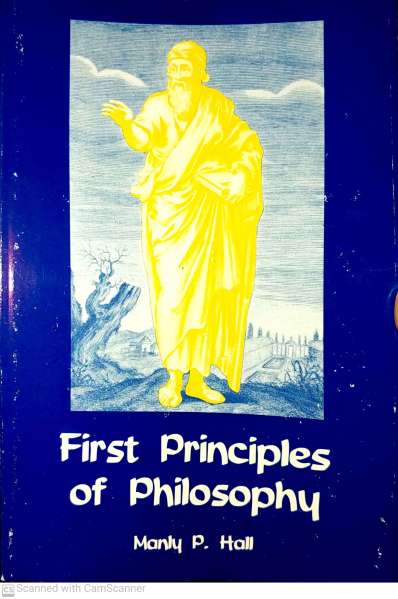
First Principles of Philosophy

I want you to look upon philosophy not as an abstract and difficult word, suggesting arduous labor, but as a simple and friendly term standing for all that is good and all that is real in knowledge.

I want you to make philosophy the great work of your life.

I want you to think of it as the greatest building power in society.

The mastery of philosophy is the supreme accomplishment of which man is capable and the living of philosophy is the most noble of all arts.

In the process of perfecting its disciples, philosophy make use of every known form of knowledge and he who perfects himself in its principles becomes truly divine.

As religion, philosophy leads to the knowledge of God.

As philosophy it leads to the knowledge of self.

And as science it leads to the knowledge and mastery of nature.

In this present age theology leads to confusion. Science, to a hopeless unbelief. Only Philosophy can bring us to “the Golden Time we look for.” Only from philosophy can we derive that enlightened courage with which to face the day. Those who have light within themselves will pass triumphantly through the difficult years which lie ahead.

Manly P. Hall

Social Degradation

Written in 1951 but is painfully more relevant now. Paragraph 2 perfectly describes social media. Goes to show no matter what tools we have available to us, we humans constantly make the same mistakes.

With conflict the dominant keynote in modern human relationships, the peacemaker is given slight consideration. He may be branded politically as a pacifist or accused of cowardice. We have long held that it is proper to maintain belligerently and aggressively both our principles and our opinions. Failure to do so is diagnosed as a deficiency of character. In spite of this, however, the long memory of the world still honors the men of peace and those kindly sages who courageously lived and died in defense of the right to be kind.

Living as we do in a social system becoming more intense and confused everyday, we are constantly tempted to become involved in the conflicts of those around us. We are expected to take sides, to defend and offend, to argue and debate, and most of all to appear appropriately disturbed. It is a social error to be composed when others are exhausting their resources in pointless agitation. To such contestants, the peacemaker is not blessed, for he reveals a measure of self-control, which is itself disquieting to the uncontrolled.

Peacemaking is not a profession; it is an instinct, and only succeeds when it is sustained by other gentle and kindly traits of character. When calmness pervades the atmosphere, radiating from a relaxed, well poised person, it is a force to be reckoned with, but when it is demanded or required by some moralizer who knows not whereof he speaks, it has no calming influence.

Manly P. Hall