Foreign Viewpoint

This means essentially that to give serious consideration to another’s viewpoint means to risk exposure to indeterminate uncertainty – to risk a rise in existential anxiety, pain and depression; to experience temporally indeterminate effective, imagistic and cognitive chaos. It is much more likely, in consequence, that a foreign viewpoint will appear evil or will come to be defined as such (especially during times rendered unstable – unbearably novel – for additional alternative reasons).

Once such definition occurs, application of aggression, designed to obliterate the source of threat, appears morally justified, even required by duty. The alternative or foreign viewpoint is in fact reasonably considered evil (although this consideration is dangerously one-sided), when viewed in terms of its potential destructive capacity, from within the strict confines of the historically determined social-psychological adaptive structure. It is only within the domain of meta-morality (which is the morality designed to update moral rules) that the strange may be tolerated or even welcomed.

Jordan Peterson

Understanding Morality

It is still the case, however, that description of the domain of morality tend to exceed the capability of declarative thought, and that the nature of much of what we think of as moral behavior is still, therefore, embedded in unconscious procedure. As a consequence, it is easy for us to become confused about the nature of morality, and to draw inappropriate, untimely and dangerous “fixed” conclusions.

Moral behaviors and schemas of valuation arise as a consequence of behavioral interaction undertaken in the social world: every individual, motivated to regulate his emotions through action, modifies the behavior of others, operating in the same environment. The consequence of this mutual modification, operating over time, is the emergence of a stable pattern of behavior, “designed” to match individual and social needs, simultaneously. Eventually, this behavioral pattern comes to be coded in image, heralded and narrative, and explicitly represented in words.

Myths of the “knowledge of good and evil” and the “fall from paradise” represent emergence of this representational capacity, in the guise of a historical event. The consequence of this “event” – that is, the development of “self-consciousness” – is capacity to represent death and understand that the possibility of death is part of the unknown.

These complex systems of action and belief are religious. They are the traditional means of dealing with the shadow cast on life by the knowledge of mortality. Our inability to understand the religious traditions and our consequent conscious denigration of their perspectives dramatically decrease the utility of what they have to offer.

We are conscious enough to destabilize our beliefs and our traditional patterns of action, but not conscious enough to understand them. If the reasons for the existence of our traditions were rendered more explicit, however, perhaps we could develop greater intrapsychic and social integrity. The capacity to develop such understanding might help us use our capacity for reason to support, rather than destroy, the moral systems that discipline and protect us.

Jordan Peterson

Primordial Chaos

The totality of the world, which includes the significance of experienced things, as well as the things themselves, is composed of what has been explored and rendered familiar; what has yet to be encountered, and is therefore unpredictable; and the process that mediates between the two.

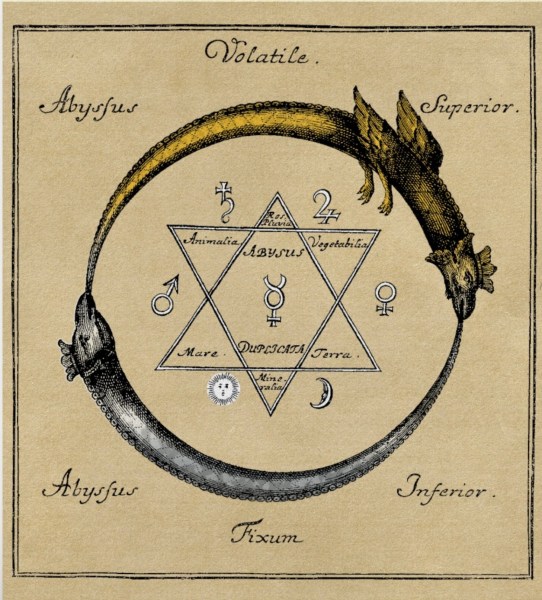
The primordial theriomorphic serpent god is endless potential; is whatever being is prior to the emergence of the capacity for experience. This potential has been represented as the self devouring dragon (most commonly) because this image aptly symbolizes the union of incommensurate opposites. Th ouroboros is simultaneously representative of two antithetical primordial elements. As a snake, the ouroboros is a creature of the ground, of matter; as a bird (a winged animal), it is a creature of the air, the sky, spirit. The ouroborus symbolizes the union of the known (associated with spirit) and unknown (associated with matter), explored and unexplored; symbolizes the juxtaposition of the “masculine” principles of security, tyranny and order with the “feminine” principles of darkness, dissolution, creativity and chaos.

Furthermore, as a snake, the ouroboros has the capacity to shed its skin – to be “reborn.” Thus, it also represents the possibility of transformation, and stands for the knower, who can transform chaos into order, and order into chaos. The Ouroboros stands for, or comprises, everything that is as of yet unencountered, prior to its differentiation as a consequence of active exploration and classification. It is a source of all information that makes up the determinant world of experience and is, simultaneously, the birthplace of the experiencing subject.

The ouroboros is one thing, as everything that has not yet been explored is one thing; it exists everywhere, and at all times. It is completely self-contained, completely self-referential: it feeds, fertilizes and engulfs itself. It unites the beginning and the end, being and becoming, in the endless circle of its existence. It serves as a symbol for the ground of reality itself. It is the “set of all things that not yet things,” the primal origin and ultimate point of return for every discriminable object and every independent subject. It serves as progenitor of all we know, all that we don’t know, and of the spirit that constitutes our capacity to know and not know. It is the mystery that constantly emerges when solutions to old problems cause new problems; is the sea of chaos surrounding man’s island of knowledge – and the source of that knowledge, as well. It is all new experience generated by time, which incessantly works to transform the temporarily predictable once again into the unknown. It has served mankind as the most ubiquitous and potent primordial gods.

Jordan Peterson

The Myth Hypothesis

…mythic stories or fantasies that guide our adaptation, in general, appear to describe or portray or embody three permanent constituent elements of human experience: the unknown, or unexplored territory; the known, or explored territory; and the process – the knower – that mediates between them. These three elements constitute the cosmos – that is, the world of experience – from the narrative or mythological perspective.

No matter where an individual lives – and no matter when – he faces the same set of problems or, perhaps, the same set of metaproblems, since the details differ in endlessly. He is a cultural creature, and must come to terms with the existence of that culture. He must master the domain of the known – explored territory – which is the set of interpretations and behavioral schemas he shares with his societal compatriots. He must understand his role within that culture – a role defined by the necessity of preservation, maintenance and transmission of tradition, as well as by capacity for the revolution and radical update of that tradition, when such update becomes necessary. He must also be able to tolerate and even benefit from the existence of the transcendental unknown – unexplored territory – which is the aspect of experience that cannot be addressed with mere application of memorized and habitual procedures. Finally, he must adapt to the presence of himself – must face the endlessly tragic problem of the knower, the exploratory process, the limited mortal subject; must serve as eternal mediator between the creative and destructive “underworld” of the unknown and the secure, oppressive patriarchal kingdom of human culture.

We cannot see the unknown, because we are protected from it by everything familiar and unquestioned. We are in addition habituated to what is familiar and known – by definition – and are therefore often unable to apprehend its structure (often even unable to perceive that is there). Finally, we remain ignorant of our own true nature, because of its intrinsic complexity, and because we act towards others and ourselves in a socialized manner, which is to say a predictable manner – and thereby shield ourselves from our own mystery. The figures of myth, however, embody the world – “visible” and “invisible.” Through the analysis of such figures, we can come to see just what meaning means, and how it reveals itself, in relationship to our actions. It is through such analysis that we can come to realize the potential breadth and depth of our own emotions, and the nature of our true being; to understand our capacity for great acts of evil – and great acts of good – and our motivations for participating in them.

Jordan Peterson

Where All Wisdom Resides

It is where the unpredictable emerges that the possibility for all new and useful information exists. It is during the process of exploration of the unpredictable or unexpected that all knowledge and wisdom is generated, all boundaries of adaptive competence extended, all foreign territory explored, mapped and mastered. The eternally extant domain of the unknown therefore constitutes the matrix from which all conditional knowledge emerges. Everything presently known to each, everything rendered predictable, was at one time unknown to all, and had to be rendered predictable – beneficial at best, irrelevant at worst – as a consequence of active of exploration driven adaptation. The Matrix is of indeterminable breath: despite our great storehouse of culture, despite the wisdom bequeathed to us by ancestors, we are still fundamentally ignorant, and will remain so, no matter how much we learn. The domain of the unknown surrounds us like an ocean surrounds an island. We can increase the area of the island, but we never take away much from the sea.

Jordan Peterson