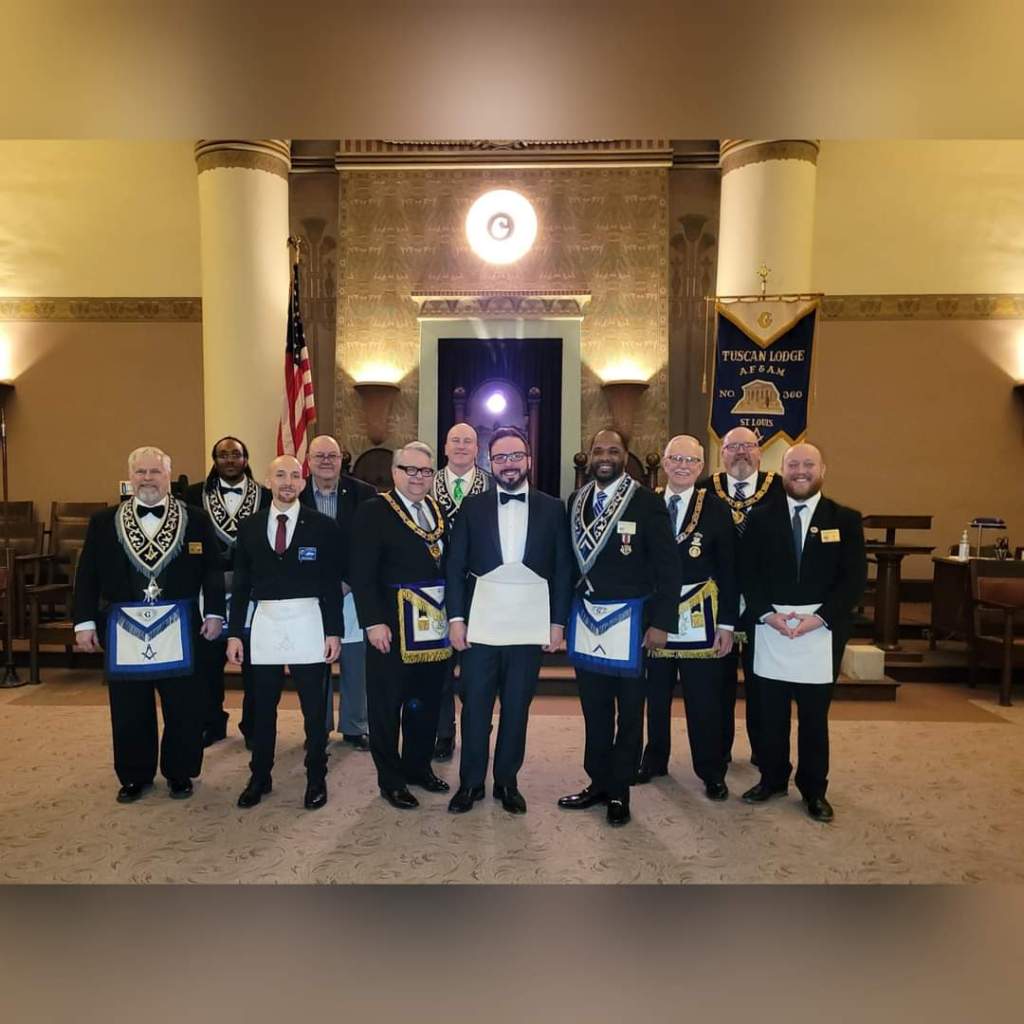
It was a huge honor and quite the experience for me to work side by side with Missouri’s Most Worshipful Grand Master and other Grand Lodge officers, in this temple.
Since it’s relevant — and I’m sure many have the question, as did I — I’d like to clarify and explain the naming convention of “Worshipful Master” we use in Freemasonry. Firstly, we do not worship any man. The term Worshipful comes from ancient England and was an honorary title that simply meant “respected” in the past. The structure of each individual lodge/temple consists of a Worshipful Master at the top and a few offers that support him. Basically, the WM (Worshipful Master) serves as the chief officer and oversees all lodge functions, lodge officer duties, and presides over each lodge meeting. He ultimately has the last say on matters but we are all considered equal.
Now, if you define worship as what most people see in the Abrahamic religions (ie. singing, prayer, sermon, praising God directly, etc.), I’d say Freemasons do not worship anyone or anything period. I know this was my definition of worship, basically just praising/kneeling to God directly, in different ways.
My definition of worship has expanded though. If you define worship as: a wide-ranged avenue to give adoration and respect to diety, a personal act of the heart rather than outward actions, and that worship can be expressed in all areas of life — then you could argue we do worship.
But I would say what we worship more specifically, isn’t diety per se, but the divine spark that resides in each of us. So worshipping the sanctity and power of the individual. Something I clearly support and stand behind.
So, long story short: Missouri has many individual temples/lodges (city to city), in each, a Worshipful Master presides over it. Each state in the U.S. has a Grand Lodge, which is the overarching governing body over all the individual lodges in the state and functions just as the rest of the lodges do. So, the Grand Lodge’s Worshipful Master title is “Most Worshipful Grand Master.”
It is true that Freemasonry is the parent of all religion, the original worldwide cosmic gnosis, diffused in ancient times to the uttermost ends of the earth. Freemasonry is the Pompeii of prehistoric science. All the Masonic ritual, it’s Egyptian signs, it’s Chaldean grips, it’s Sanskirt passwords, is ancient Hebrew symbols, it’s cabalistic allusions and its historical records are supremely scientific and a survival through long ages, by various underground channels, of the knowledge of the universe which was gained by Sabian astronomers from the temple tops of Chaldea, India and China and recorded by the equally learned geometers and mathematicians of the ancient Orient.
Partially what has inspired me, and led me to the path that I’m on, is watching and learning from the great Symbolists. People that can readily and pragmatically, extract meaning from, and interpret, esoteric/occult/religious symbolism, art and the like. People that approach dreams, the imagination and spirituality, with a more academic approach. I want to be able to see the world as they do, because they see the world in a completely different way than the lay person.
So one of the main focuses in my study is the development of my intuition, with the intention of being able to understand and interpret the universal language of symbolism. As you can imagine, or know from experience, this is very difficult to do. Partially because symbolism is intentionally vague, yet has to be interpreted through a certain framework. You have to train your intuition and study the roots of the symbology academically.
Starting out years ago, I wasn’t able to extract hardly any sort of meaning, from any kind of symbolism and/or art. I’d look at say a tarot card, and get nothing out of it without looking up what everything means, and relying on other people’s interpretation, which defeats the purpose of esoteric/occult symbolism.
I see a lot of people (and this was myself in the past) ask: “What does this image mean?”. No one can tell you what the image means. Esoteric and occult symbolism is intentionally vague to allow the individual to impart their own personal level of interpretation (again, still limited within a certain framework). The subtle aspects of our nature is what makes us more than who we are, more than just an animal, or just material elements in a meat sack. The things that you can’t quite explain, feelings and meanings you can’t articulate, phenomenon that can’t be explained by material science – it’s these aspects of our being that esoteric/occult symbolism is supposed to communicate with. It’s supposed to invite these divine, subtle aspects of our nature to step forward. The meaning has to come from within.
For years I have had the same problem I described above, about not being able to extract meaning from the symbolism. Finally, after many years of research, study and training, I have gotten to a point where I’m starting to intuit meaning from the art. It sort of just hit me out of no where. I guess a piece of the divine spark has touched me. So I’d like to share one of my recent interpretations. Partly because I’m very proud of myself, but majoraly because I want to let people in on how profound this ability is.
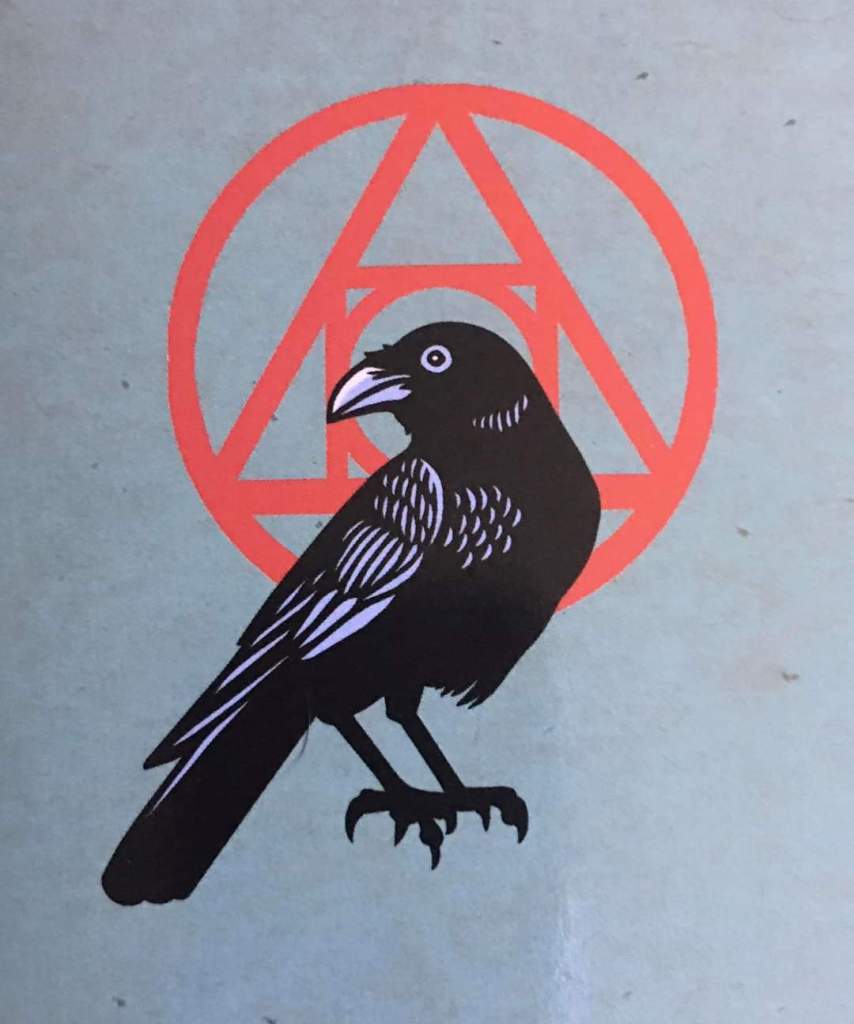
Below will be my interpretation of this image. For people not read on hermetic or qabbalistic philosophy, you’ll likely see most of this as gibberish. A quick Google search on the hermetic principle of the “All”, and a search on the alchemical “magnum opus”, will definitely help and for the most part, get you up to speed.
For me the raven represents sort of the most evolved intelligence in the bird kingdom – specifically noting how social and intuitive they are. Plus all the other traditional meanings birds imply. So in other words the most advanced state of consciousness in the bird kingdom.
Seeing the circle, encapsulated (or perhaps “nested”) in the square, the square in the triangle, and triangle in the circle, represents a totality of the structure of our material and divine constitution within the “All” (the hermetic and qabbalistic concept of the All).
I see the first circle as me (us – humans), it’s the “dot” or “point” (perhaps one individual seed of conciousness), radiating out, unfolded in its highest, most divine form, yet still encapsulated in this material realm.
The square, or us in the four fold material realm, is us realized to it’s most divine capacity, partaking or touching the higher, divine, trinitarian, ethereal realm of spirit. So that threefold aspect of divine cosmic spirit is nested within the “limitless and boundless” All (again I’m speaking in hermetic and qabbalistic terms).
So I see this image sort of as a reminder of what is possible with our “baser” self(s). The raven also intimates towards the alchemical philosophers stone or the magnum opus. A reminder that with just base elements you can create something evolved to its highest potential (ie. the raven), something that takes part in, or something that becomes divine. That with mastery over the material and spiritual realms, we can bring ourselves back to unity with the All.
But the deeper meaning this image has for me, I can’t articulate. This is why I love esoteric and occult symbolism. Partly because with just some simple symbols you can convey truths and realities that cannot be articulated. As I stated above, just as the subtle parts of the raven is what makes it divine, and the subtle parts of our nature is what makes us divine, occult symbolism speaks to that higher more ethereal parts of our nature. It stimulates and invites out our divine nature to step forward. The universal language of symbolism is a direct path to diety and brings you closer to divinity with every step. This is a Symbolist’s vision.
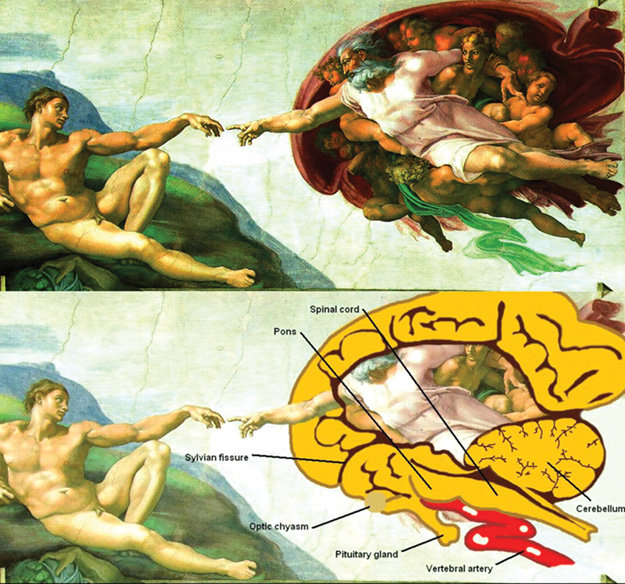
Nearly all the sacred books of the world can be traced in anatomical analogy. This is most evident in their creation myths.
Proceeding from this assumption of the first theologians that man is actually fashioned in the image of God, the initiated minds of past ages erected the stupendous structure of theology on the foundation of the human body. The religious world of today is almost totally ignorant of the fact that the science of biology is the fountainhead of its doctrines and tenants. Many of the codes and laws believed by modern divines to have been direct revelations from Divinity are in reality the fruitage of ages of patient delving into the intricacies of the human constitution and the infinite wonder is revealed by such a study.
Christianity itself may be cited as an example.
The entire New Testament is in fact an ingenuously concealed exposition of the secret processes of human regeneration. The characters so long considered as historical men and women are really the personification of certain processes which take place in the human body when man begins the task of consciously liberating himself from the bondage of ignorance and death.
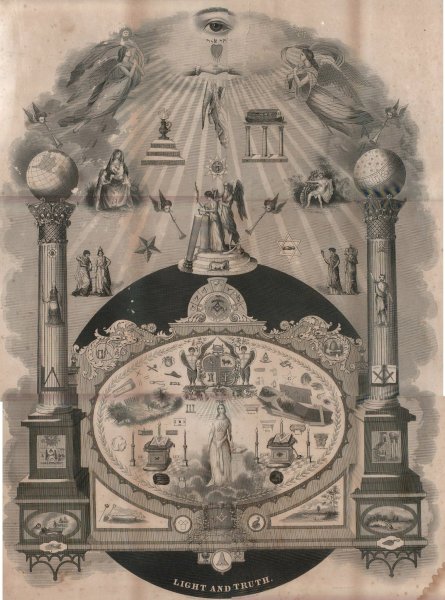
The sanctum sanctorum of Freemasonry is ornamented with the gnostic jewels of a thousand ages; its rituals ring with the divinely inspired words of seers and sages. A hundred religions have brought their gifts of wisdom to its altar; arts and sciences unnumbered have contributed to its symbolism. Freemasonry is a world-wide university, teaching the liberal arts and sciences of of the soul to all who will hearken to its words. It’s chairs are seats of learning and its pillars uphold an arch of universal education.
The philosophic power of Freemasonry lies in its symbols – it’s priceless heritage from the Mystery schools of antiquity. In a letter to Robert Freke Gould, Albert Pike writes:
“In it’s symbolism, which and it’s spirit of brotherhood are its essence, Freemasonry is more ancient than any of the world’s living religions. …”
Though Zoroaster, Hermes, Pythagoras, Plato. and Aristotle are now but dim memories in a world once rocked by the transcendency of their intellectual genius, still in the mystic temple of Freemasonry these god-men live again in their words and symbols; and the candidate, passing through the initiations, feels himself face-to-face with these illumined heirphants of days long past.
I want you to look upon philosophy not as an abstract and difficult word, suggesting arduous labor, but as a simple and friendly term standing for all that is good and all that is real in knowledge.
I want you to make philosophy the great work of your life.
I want you to think of it as the greatest building power in society.
The mastery of philosophy is the supreme accomplishment of which man is capable and the living of philosophy is the most noble of all arts.
In the process of perfecting its disciples, philosophy make use of every known form of knowledge and he who perfects himself in its principles becomes truly divine.
As religion, philosophy leads to the knowledge of God.
As philosophy it leads to the knowledge of self.
And as science it leads to the knowledge and mastery of nature.
In this present age theology leads to confusion. Science, to a hopeless unbelief. Only Philosophy can bring us to “the Golden Time we look for.” Only from philosophy can we derive that enlightened courage with which to face the day. Those who have light within themselves will pass triumphantly through the difficult years which lie ahead.
Looking at the Bible through this lense shows that the Bible is a historical documentation of the human behavioral tradition, from the demands of adaptation to nature, in the form of heuristics.
The (explicit) moral code is validated by reference to the (religious, mythic) narrative, the narrative; is primarily episodic representation of behavioral tradition; the tradition emerges as a consequence of individual adaptation to the demands of natural conditions, manifest (universally) in emotion, generated in a social context. The episodic representation – which is representation of the outcome of a procedure and the procedure itself – is predicated upon belief in the sufficiency and validity of that procedure; more subtly, it has the same structure – at least insofar as it is an accurate representation of behavior – and therefore contains the (implicit) hierarchical structure of historically determined procedural knowledge in more explicit form. Over lengthy historical periods, therefore, the “image” ever more accurately encapsulates the behavior, and stories find their compelling essential form.
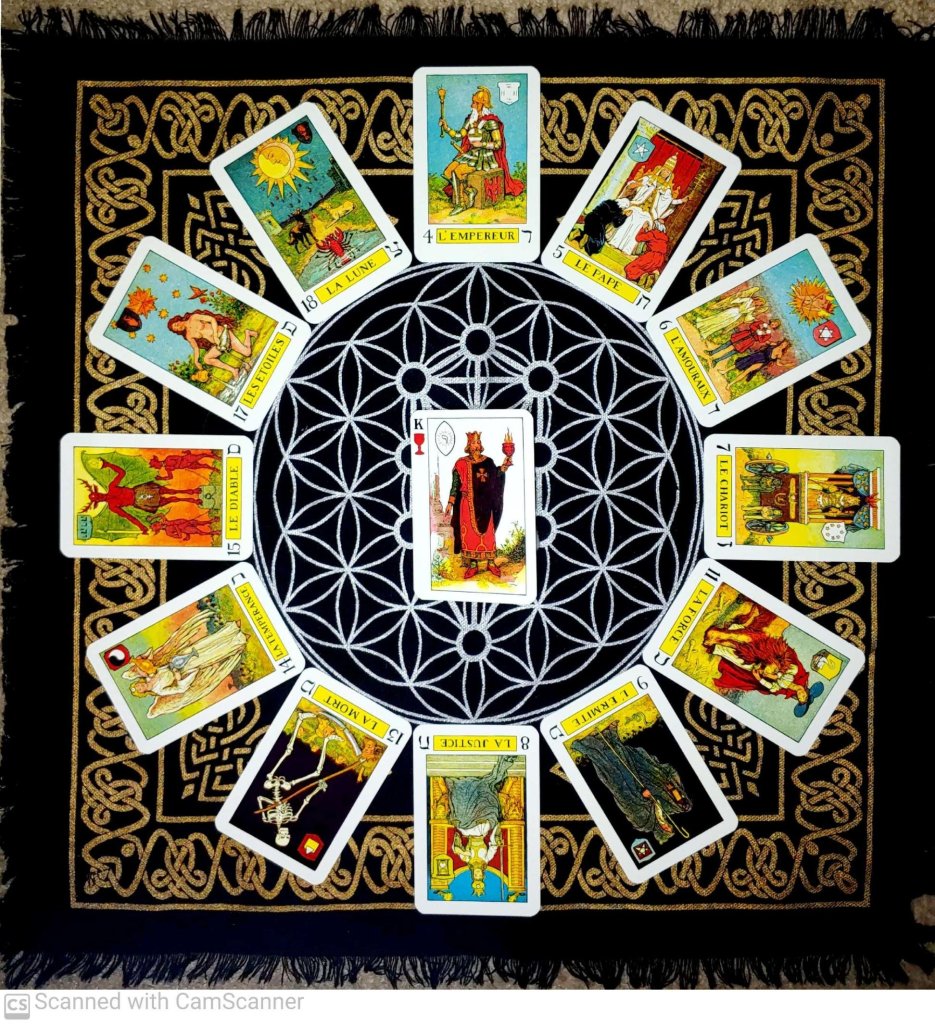
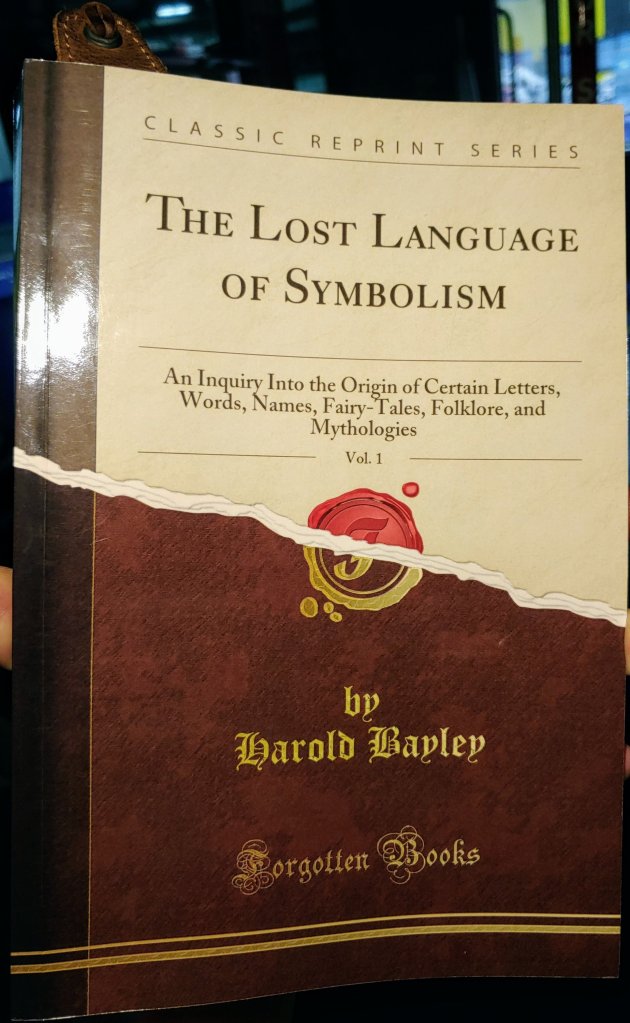
I’m trying to absorb as much as I can about the language of Symbolism to aid in my understanding of the Tarot.
Although etymologists are agreed that language is fossil poetry and that the creation of every word was originally a poem embodying a bold metaphor or a bright conception, it is quite unrealised how close and intimate relation exists between symbolism and philology.
The mechanism of the Tarot like that of other divinatory or prophetic techniques, “is a universal phenomenon, for such techniques are based upon the higher activity of the unconscious in response to certain stimuli, and upon the automatic acquisition of unconscious stores of knowledge remaining unperceived until ‘read’ in accordance with the principles of numbers, orientation, form and space.”



 ErudiTarot