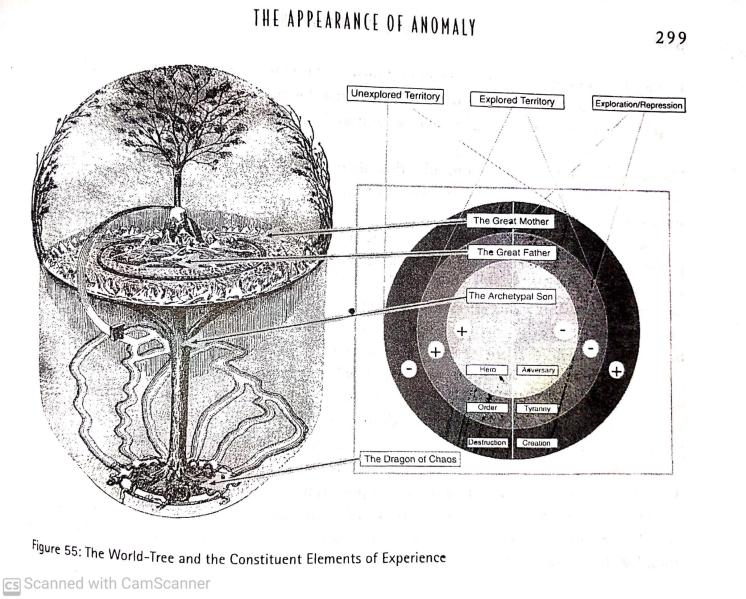
The totality of the world, which includes the significance of experienced things, as well as the things themselves, is composed of what has been explored and rendered familiar; what has yet to be encountered, and is therefore unpredictable; and the process that mediates between the two.
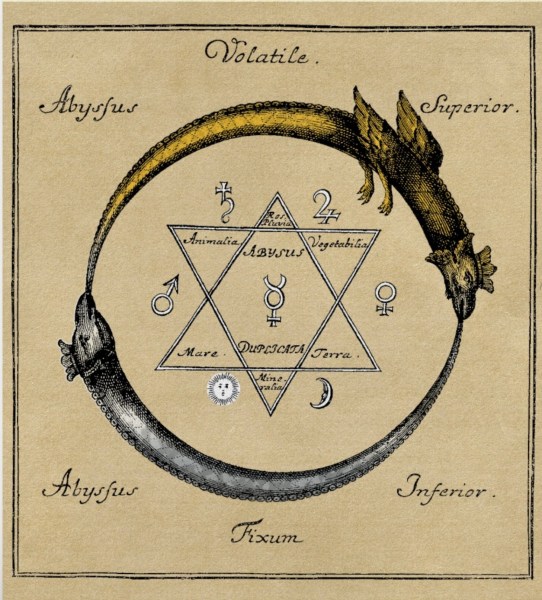
The primordial theriomorphic serpent god is endless potential; is whatever being is prior to the emergence of the capacity for experience. This potential has been represented as the self devouring dragon (most commonly) because this image aptly symbolizes the union of incommensurate opposites. Th ouroboros is simultaneously representative of two antithetical primordial elements. As a snake, the ouroboros is a creature of the ground, of matter; as a bird (a winged animal), it is a creature of the air, the sky, spirit. The ouroborus symbolizes the union of the known (associated with spirit) and unknown (associated with matter), explored and unexplored; symbolizes the juxtaposition of the “masculine” principles of security, tyranny and order with the “feminine” principles of darkness, dissolution, creativity and chaos.
Furthermore, as a snake, the ouroboros has the capacity to shed its skin – to be “reborn.” Thus, it also represents the possibility of transformation, and stands for the knower, who can transform chaos into order, and order into chaos. The Ouroboros stands for, or comprises, everything that is as of yet unencountered, prior to its differentiation as a consequence of active exploration and classification. It is a source of all information that makes up the determinant world of experience and is, simultaneously, the birthplace of the experiencing subject.
The ouroboros is one thing, as everything that has not yet been explored is one thing; it exists everywhere, and at all times. It is completely self-contained, completely self-referential: it feeds, fertilizes and engulfs itself. It unites the beginning and the end, being and becoming, in the endless circle of its existence. It serves as a symbol for the ground of reality itself. It is the “set of all things that not yet things,” the primal origin and ultimate point of return for every discriminable object and every independent subject. It serves as progenitor of all we know, all that we don’t know, and of the spirit that constitutes our capacity to know and not know. It is the mystery that constantly emerges when solutions to old problems cause new problems; is the sea of chaos surrounding man’s island of knowledge – and the source of that knowledge, as well. It is all new experience generated by time, which incessantly works to transform the temporarily predictable once again into the unknown. It has served mankind as the most ubiquitous and potent primordial gods.
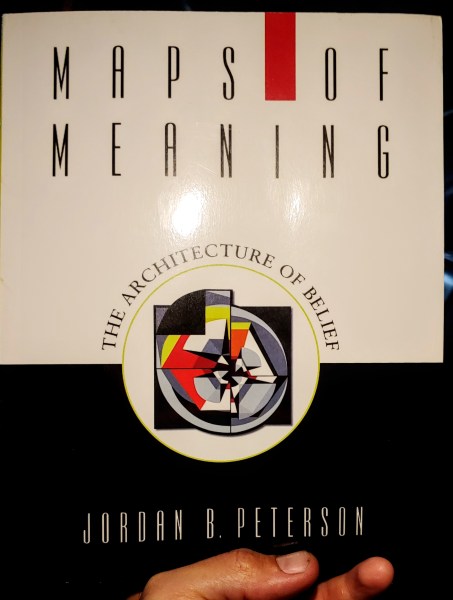
Jordan Peterson




 ErudiTarot